

Ideal Weight Calculator
Enter your height to see the usual adult weight range for it, in lb or kg. Add your weight to see where it falls.
How your weight range is worked out
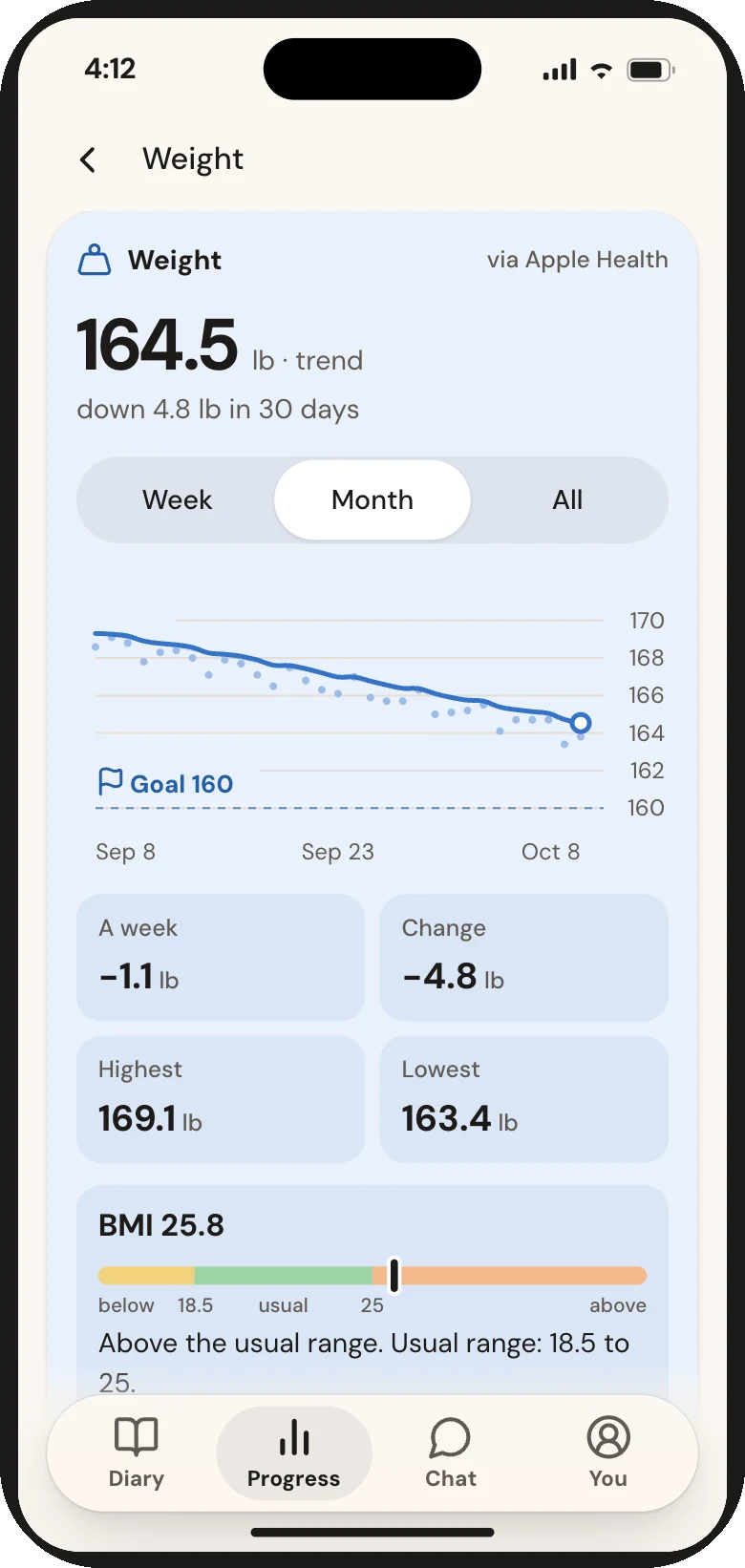
It's the same range the Calsa app shows on your weight screen.
1. Height × height
Your height in metres, squared. At 165 cm: 1.65 × 1.65 = 2.72.
2. × 18.5 and × 24.9
The usual adult BMI range from the World Health Organization. At 165 cm that's 50.4 to 67.7 kg, or 111.1 to 149.4 lb.
3. One range for everyone
BMI uses only height and weight, so the range is the same for women and men, at 25 or at 60. Children use growth charts instead.
4. The low end is the lowest goal
At 165 cm Calsa sets no weight-loss goal under 50.4 kg. Keeping or gaining weight is open at any weight.
Height and weight chart for adults
The usual range at each height from 4 ft 10 in to 6 ft 5 in. The same table applies to women, men and every adult age.
| Height | Pounds | Kilograms |
|---|---|---|
| 4 ft 10 in147 cm | 88.6–119.1 | 40.2–54.0 |
| 4 ft 11 in150 cm | 91.6–123.2 | 41.6–55.9 |
| 5 ft 0 in152 cm | 94.8–127.4 | 43.0–57.8 |
| 5 ft 1 in155 cm | 98.0–131.7 | 44.5–59.7 |
| 5 ft 2 in157 cm | 101.2–136.1 | 45.9–61.7 |
| 5 ft 3 in160 cm | 104.5–140.5 | 47.4–63.7 |
| 5 ft 4 in163 cm | 107.8–145.0 | 48.9–65.8 |
| 5 ft 5 in165 cm | 111.2–149.6 | 50.5–67.8 |
| 5 ft 6 in168 cm | 114.7–154.2 | 52.0–69.9 |
| 5 ft 7 in170 cm | 118.2–158.9 | 53.6–72.1 |
| Height | Pounds | Kilograms |
|---|---|---|
| 5 ft 8 in173 cm | 121.7–163.7 | 55.2–74.2 |
| 5 ft 9 in175 cm | 125.3–168.6 | 56.9–76.4 |
| 5 ft 10 in178 cm | 129.0–173.5 | 58.5–78.7 |
| 5 ft 11 in180 cm | 132.7–178.5 | 60.2–80.9 |
| 6 ft 0 in183 cm | 136.5–183.5 | 61.9–83.2 |
| 6 ft 1 in185 cm | 140.3–188.7 | 63.7–85.6 |
| 6 ft 2 in188 cm | 144.1–193.9 | 65.4–87.9 |
| 6 ft 3 in191 cm | 148.1–199.2 | 67.2–90.3 |
| 6 ft 4 in193 cm | 152.0–204.5 | 69.0–92.7 |
| 6 ft 5 in196 cm | 156.1–209.9 | 70.8–95.2 |
Why there's no single ideal weight
A range for your height beats one number.
Devine published his formula in 1974 to dose an antibiotic, not to set anyone's goal. Robinson, Miller and Hamwi wrote close variations, and a 2000 review in the Annals of Pharmacotherapy traced all of them back to old height-weight tables. Most "ideal body weight" calculators still run on them.
BMI has limits too. It can't tell muscle from fat, so a muscular person can sit above the range. NICE in the UK adds a waist check: keep your waist to less than half your height. It also uses a lower point, BMI 23, for people of South Asian, Chinese, other Asian, Middle Eastern, Black African or African-Caribbean family background.
Your weight also moves from one morning to the next with salt, water and food, so the trend over weeks tells you more than any one weigh-in.

Questions about weight for your height
How much should I weigh?
Find your height in the chart: at 5 ft 6 in the usual adult range is 114.7–154.2 lb (52.0–69.9 kg), a BMI of 18.5 to 24.9 as set by the World Health Organization. Women and men use the same range, and so does every adult age, though NICE asks doctors to read BMI with care over 65. The range is about 40 lb wide at that height, so a weight near either end says little by itself.
What is a healthy BMI?
For adults the World Health Organization's usual range is 18.5 to 24.9, for women and men alike. BMI is weight in kilograms divided by height in metres squared, so 140 lb at 5 ft 6 in works out to 22.6. NICE in the UK starts looking at weight-related health risks from a lower point, BMI 23, for several family backgrounds, including South Asian and Chinese.
What is my ideal weight?
There is no single number. At 5 ft 6 in the usual range is about 40 lb wide, and which end suits you depends on things the calculator can't see, such as muscle. Take the range for your height, then watch your weekly average instead of one morning's reading.
How to calculate ideal body weight?
Take 50 kg for a man at 5 ft or 45.5 kg for a woman, then add 2.3 kg for each inch over. This is the Devine formula from 1974, and it gives 54.7 kg (120.6 lb) for a woman at 5 ft 4 in and 70.7 kg (155.9 lb) for a man at 5 ft 9 in. Both land inside the BMI range for those heights. Devine built it to dose a drug, not to set a goal.
What is a healthy weight for a 5'4 or 5'5 female?
At 5 ft 4 in (163 cm) the usual range is 107.8–145.0 lb (48.9–65.8 kg). At 5 ft 5 in (165 cm) it is 111.2–149.6 lb (50.5–67.8 kg). A man of the same height has the same range, because BMI uses only height and weight. If you set a weight-loss goal in Calsa, the lowest it accepts at your height is the bottom of this range.
What is a healthy weight for a 6 foot male?
At 6 ft 0 in (183 cm) the usual range is 136.5–183.5 lb (61.9–83.2 kg). A man who lifts can sit above the top with little body fat, because BMI can't tell muscle from fat. NICE adds a waist check for that case: keep your waist under half your height, which is 36 in (91 cm) at 6 ft.
How much should I weigh at 5'9?
At 5 ft 9 in (175 cm) the usual range is 125.3–168.6 lb (56.9–76.4 kg). Each inch of height moves the range by about 3 to 5 lb, so 5 ft 10 in is 129.0–173.5 lb. Measure your height before you read the chart, because a rounded inch changes the numbers.
How much weight is healthy to lose in a month?
Calsa sets a pace of 0.25, 0.5 or 0.75 kg a week, which is about 1, 2 or 3 kg a month (2, 5 or 7 lb). It never goes above 1% of your weight a week, so 0.75 kg a week opens at 75 kg and a 70 kg person tops out at 0.5. Weigh-ins swing with water and salt, so judge the month by the trend line, not the first and last morning. The calorie calculator shows the daily calories for each pace.