

Macro Calculator
Your daily calories as grams of protein, fat and carbs. Protein is set first, from your weight. The calorie total never goes below 1,200 or 1,500, depending on the formula.
How your macros are calculated
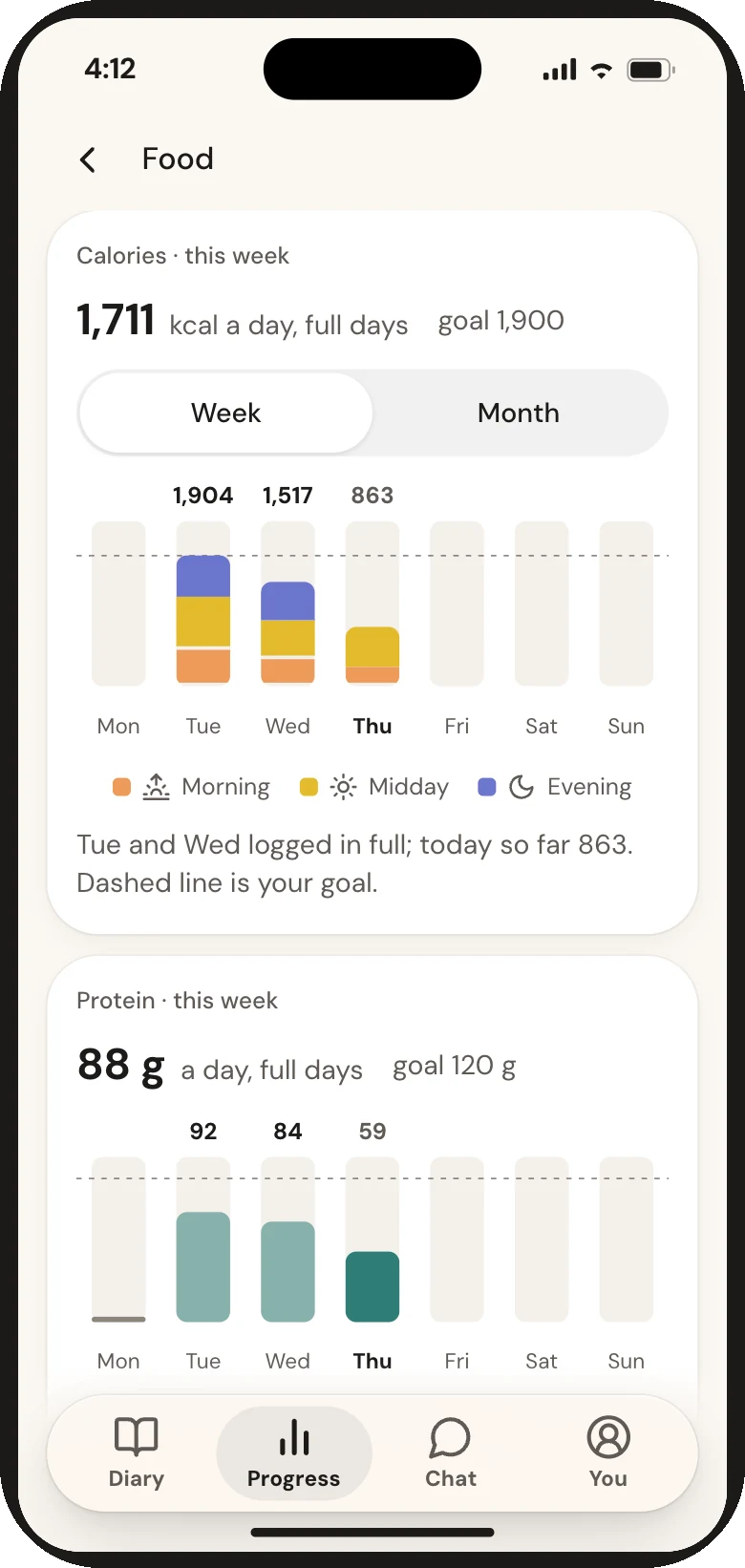
The Calsa app sets your macros the same way.
1. Calories
Your daily goal comes from the NASEM 2023 equations and your pace. It won't go below 1,200 or 1,500.
2. Protein: 1.2 to 1.6 g per kg
Measured on your weight up to a BMI of 25, and on the weight at a BMI of 25 above that. At least 60 g, and never more than 35% of your calories.
3. Fat: 30% of calories
Move the slider anywhere from 20 to 35%. That's the range the US National Academies give for adults.
4. Carbs: what's left
Whatever's left after protein and fat, divided by 4. Fiber is on top: at least 14 g for every 1,000 calories.
Grams to calories
Multiply grams by these three numbers to get calories back. Use them to check a label or your own day.
1 g protein = 4 kcal
120 g of chicken breast has about 37 g of protein, so about 150 calories from protein.
1 g fat = 9 kcal
A tablespoon of olive oil, about 14 g of fat, is about 120 calories.
1 g carbs = 4 kcal
A cup of cooked rice has about 45 g of carbs, so about 180 calories from carbs.
Tracking and calculating macros
How to track macros?
Weigh each food in grams, read the protein, fat and carbs per 100 g on the label, and scale to what you ate: 20 g of protein per 100 g is 30 g in a 150 g serving. Log each meal when you eat it, not at night from memory. Weigh raw or cooked, not both, because cooked rice has far fewer carbs per 100 g than dry rice. At the end of the day check the grams: 4 × protein + 4 × carbs + 9 × fat should land near the calories of the entry, and if it does not, a number is mistyped.
What are macros?
Macros, short for macronutrients, are the three nutrients that give food its calories: protein and carbs at 4 calories per gram, fat at 9. A macro goal splits your calorie goal into grams of each, so 1,690 calories can read as 82 g protein, 56 g fat and 214 g carbs.
What are macros in food?
They are the Protein, Total Fat and Total Carbohydrate lines on the label. A US label gives them per serving and many other countries print them per 100 g, so check which one you are reading before you log. Fiber sits inside total carbohydrate.
What should my macros be?
Protein at 1.2 to 1.6 g per kg of reference weight (your weight, capped at BMI 25), fat at 20 to 35% of calories, and carbs for the rest. Losing 0.5 kg a week, a lightly active woman of 35, 165 cm and 68 kg gets 1,690 calories: 82 g protein, 56 g fat, 214 g carbs. A man of 35, 180 cm and 90 kg gets 2,490: 97 g protein, 83 g fat, 339 g carbs.
How to calculate macros for weight loss?
Set the calories first, then protein from your weight, then fat at 20 to 35% of calories, and let carbs take the rest. For the woman above: 82 g protein × 4 = 328 calories, fat at 30% = 507 calories ÷ 9 = 56 g, and the 855 calories left ÷ 4 = 214 g carbs. Protein is set before the cut, so the calories you remove come out of fat and carbs.
How to count macros for weight loss?
Hit your calories and your protein grams: 1,690 and 82 g in the example above. Plan the protein food for each meal first, then fill the remaining calories with carbs and fat. The split between those two is flexible, since 10 g of fat holds the calories of about 22 g of carbs.