

kJ to Calories Converter
Type kilojoules to get Calories, or Calories to get kilojoules. One Calorie is 4.184 kJ.
How to convert kJ to Calories
Divide kJ by 4.184 to get Calories. Multiply Calories by 4.184 to get kJ.
Cal = kJ ÷ 4.184
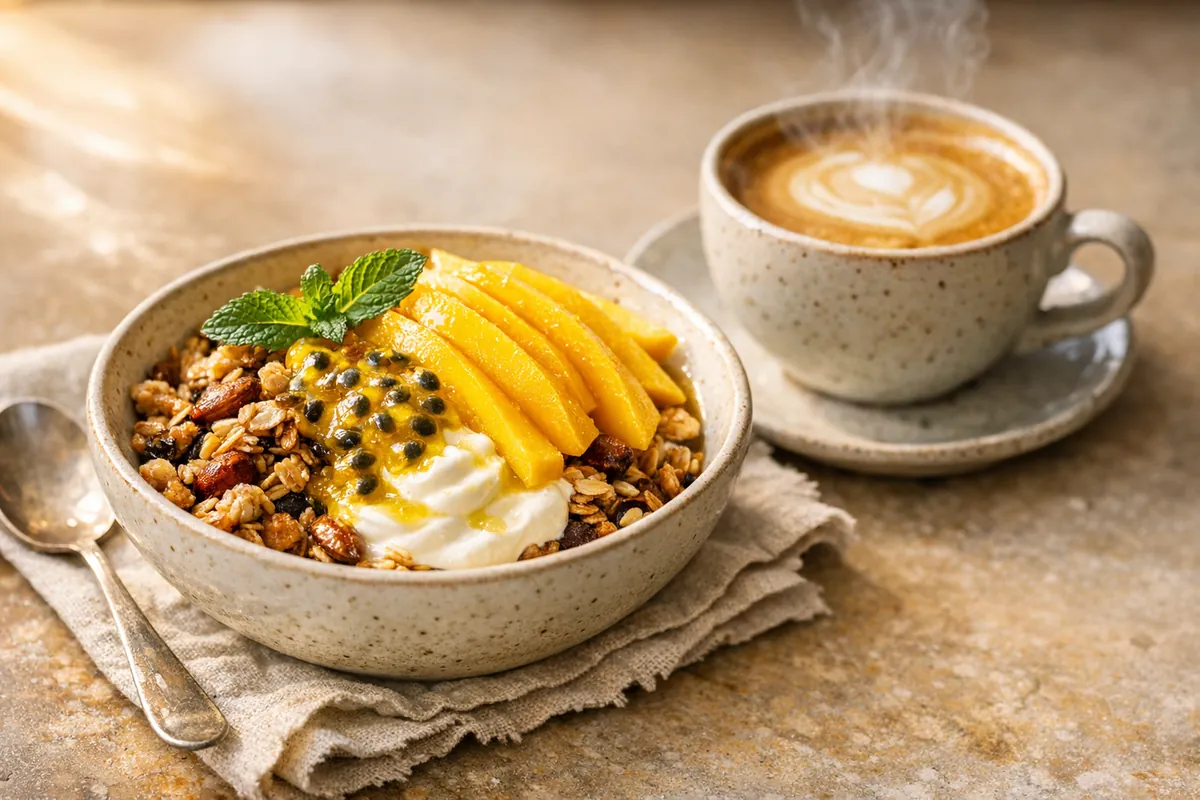
A muesli bar with 600 kJ has 600 ÷ 4.184 = 143 Calories.
kJ = Cal × 4.184
A 250 Calorie snack is 250 × 4.184 = 1,046 kJ.
In your head: ÷ 4, then −5%
1,000 kJ ÷ 4 = 250, minus 5% is about 238. The exact answer is 239.
Reading an Australian nutrition label
Every pack carries the same panel. Four spots on it decide whether your count is right.
| Servings per package: 25 Serving size: 30 g 2 | |||
| Nutrient | Avg quantity per serving | % Daily intake* per serving | Avg quantity per 100 g 3 |
|---|---|---|---|
| Energy1 | 480 kJ (115 Cal) | 6% | 1600 kJ (382 Cal) |
| Protein | 3.0 g | 6% | 10.0 g |
| Fat, total | 1.8 g | 3% | 6.0 g |
| – saturated | 0.4 g | 2% | 1.2 g |
| Carbohydrate | 19.2 g | 6% | 64.0 g |
| – sugars | 5.4 g | 6% | 18.0 g |
| Sodium | 36 mg | 2% | 120 mg |
* Percentage daily intakes are based on an average adult diet of 8700 kJ. 4
- 1
Energy is in kilojoules
Calories in brackets are optional. Plenty of packs skip them, so divide the kJ by 4.184.
- 2
Per serving is the maker's serve
Here it's 30 g. If your bowl holds 60 g, double the per-serving kJ, or weigh the bowl and work from the per 100 g column.
- 3
Per 100 g is for comparing
Use this one in the aisle. Two cereals with different serve sizes only line up here, and the one with the smaller serve can turn out to be the richer food once you read per 100 g.
- 4
% daily intake uses 8,700 kJ
That's about 2,079 Calories, the same fixed number on every pack, not a target set for you.
The 8,700 kJ reference and the panel layout are set by the Australia New Zealand Food Standards Code.
kJ and Calories at a glance
Rounded to the nearest whole number. The 8,700 kJ row is the label reference.
| kJ | Calories |
|---|---|
| 100 kJ | 24 Cal |
| 250 kJ | 60 Cal |
| 500 kJ | 120 Cal |
| 1,000 kJ | 239 Cal |
| 2,000 kJ | 478 Cal |
| 3,000 kJ | 717 Cal |
| 5,000 kJ | 1,195 Cal |
| 8,700 kJ · label reference | 2,079 Cal |
| Calories | kJ |
|---|---|
| 100 Cal | 418 kJ |
| 200 Cal | 837 kJ |
| 300 Cal | 1,255 kJ |
| 500 Cal | 2,092 kJ |
| 1,000 Cal | 4,184 kJ |
| 1,500 Cal | 6,276 kJ |
| 2,000 Cal | 8,368 kJ |
| 2,500 Cal | 10,460 kJ |
Calories, kcal and kJ
1 Cal = 1 kcal = 4.184 kJ
All three measure the energy in food. The Calorie on a label, with a capital C, is a kilocalorie, or kcal. The kilojoule is the metric unit for the same thing. That's why the kJ number on a pack is always about four times the Calorie number. If a muffin says 1,600, check which one you're reading.
Australia and New Zealand lead with kilojoules. In the US and Canada, labels and people both talk in Calories. UK labels print both, kJ first, though most people there still say calories. If a US recipe or diet article gives Calories, convert them before you compare with your packs.
Questions about kJ and Calories
How many kJ in a Calorie?
One Calorie is 4.184 kJ, so 500 Calories is 2,092 kJ. Multiply by 4.184, not 4.2: 4.2 comes out 0.4% high, which is fine for a rough guess but not for a diary.
How many kJ per day?
Australian labels use 8,700 kJ (about 2,079 Calories) for their % daily intake, the average adult diet. It's a label reference, not a target for you. A 35-year-old woman, 165 cm and 68 kg, needs 8,703 kJ a day to hold her weight if she mostly sits and 9,373 if she's lightly active. The Calsa calorie calculator has a kJ switch for your own number.
How many kJ per day for a woman to lose weight?
It depends on age, height, weight and activity, so there's no one figure. The same lightly active woman, losing about 0.5 kg a week, eats 7,071 kJ a day: 2,302 kJ under her 9,373 kJ maintenance. Calsa never sets a goal under 5,021 kJ on the female formula, or 6,276 kJ on the male one and for "prefer not to say".
How many kJ should I burn a day?
You already burn your maintenance number whether you exercise or not: 8,703 kJ for the example woman if she mostly sits, 10,963 kJ if she's very active. There's no kJ target to hit in a workout. Enter your normal week in the calculator, not your best one.
What are kilojoules, and is kJ the same as Calories?
A kilojoule is the metric unit of energy. A Calorie, capital C, is a kilocalorie, an older unit for the same thing, so kJ and Calories measure the same energy with different numbers. Australian and New Zealand food law requires kJ on the nutrition information panel. Calories in brackets are optional.
How do I convert kJ to Calories?
Divide by 4.184, so 1,000 kJ is 239 Calories. On the muesli panel above, 480 kJ a serve is 115 Calories, the same as the bracket. Convert the per serving column to log what you ate.