How to Stop Snacking at Night Without Ending the Day Hungry
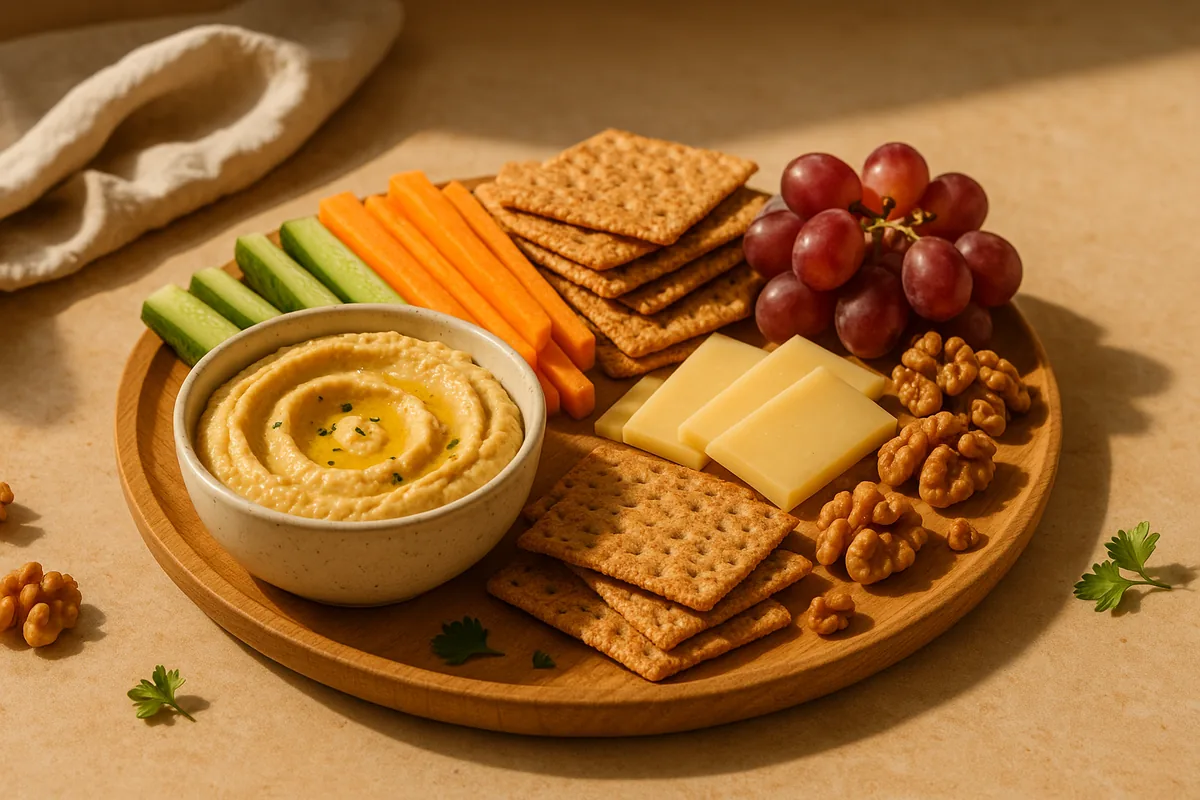
Plan the night snack instead of fighting it: about 10% of the day, or 160 kcal on a 1,600 kcal target and 200 kcal on 2,000, weighed in grams after a day that fed you.
Key takeaways
- One published diet study split daily calories 25%, 30%, 35% and 10%, the last for a 9 pm snack, which is 160 kcal on a 1,600 kcal day and 200 kcal on 2,000.
- In a 13-day lab study of 12 adults, hunger peaked around 8 pm and was lowest around 8 am, a 17% difference between peak and trough.
- Greek yogurt (170 g) with banana (115 g) comes to 205 kcal from USDA records, and apple (180 g) with almonds (14 g) to 181 kcal.
- On a 5.5-hour bedtime, 11 volunteers got 1,087 kcal a day from snacks against 866 kcal on 8.5 hours, with meals about the same.
- A pooled analysis of 11 sleep studies found 385 kcal more eaten a day after partial sleep restriction, with a 95% interval of 252 to 517 kcal.
Here is how to stop snacking at night without ending the day hungry: give the evening its own calorie slot, and check that the day before it fed you. I worked out what that looks like in grams. It rests on one published diet plan that set aside 10% of the day for a 9 pm snack, plus papers on evening hunger, sleep and meal timing. None of it needs a rule about what you may eat.
How to stop snacking at night: where do the calories go?
A night slot is a portion of food you decide on in advance and count inside the day’s target. It isn’t a reward and it isn’t an exception. The sizing comes from a two-week diet study in which daily calories were split 25% at breakfast, 30% at lunch, 35% at dinner and 10% at a 9 pm snack. I’m borrowing the split, not the diet. Those volunteers ate under supervision, and I wouldn’t pass their calorie level on to you.
Start with your daily target. The NHS suggests cutting around 600 calories a day from what you eat now, and the calorie calculator gives a starting figure from your age, height, weight and activity. It uses the NASEM 2023 equations and keeps every goal at or above a floor of 1,200 calories for the female formula and 1,500 for the male one.
Then multiply. Here are two targets, with each cell worked as target × share.
| Meal | Share of day | At 1,600 kcal | At 2,000 kcal |
|---|---|---|---|
| Breakfast | 25% | 400 kcal | 500 kcal |
| Lunch | 30% | 480 kcal | 600 kcal |
| Dinner | 35% | 560 kcal | 700 kcal |
| Evening slot | 10% | 160 kcal | 200 kcal |
So 1,600 × 0.10 is 160 kcal, and 2,000 × 0.10 is 200. Those two cells are the whole plan for the evening. A 10% slot grows with the target, so a bigger target means a bigger slot and a small target means a small one.
If a small slot feels too small, don’t borrow from dinner. Check the target itself with the calculator, or ask whoever set your plan. One thing that does not work is cutting the slot to nothing on a day you ate lunch short. The slot then has to cover a gap it was never sized for.
Do this today: take your target, multiply by 0.10, and write that number on the evening line of your plan.
What does a 200 kcal evening slot weigh?
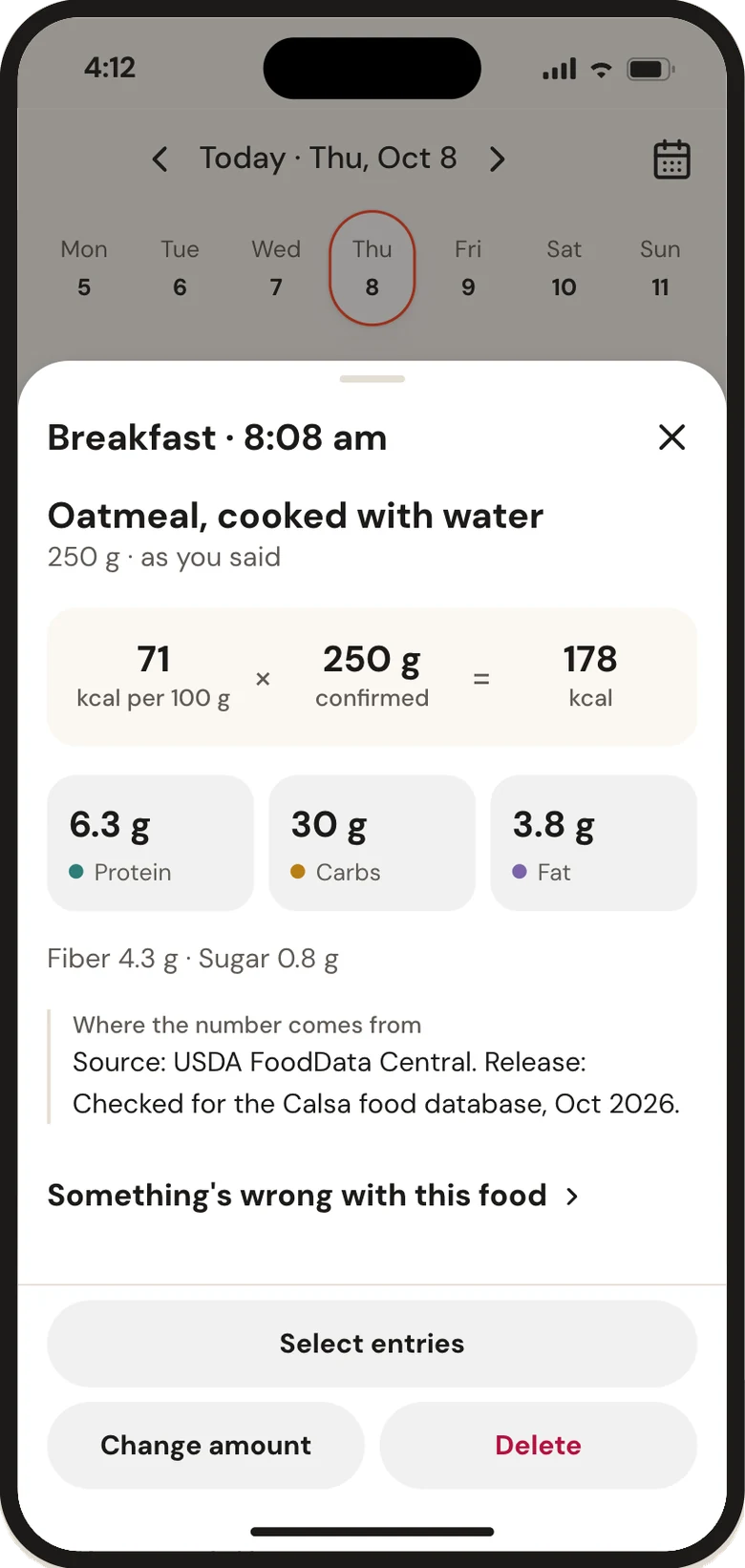
It is a small amount of food, so weigh it. I built four example slots from USDA FoodData Central records, and the gram amounts are my picks. For each food, kcal equals grams times the record’s energy per hundred grams, divided by one hundred. Then I added the pair.
| Slot | Food and grams | kcal per 100 g | Food kcal | Slot total |
|---|---|---|---|---|
| A | Greek yogurt, plain, nonfat, 170 g | 61 | 104 | 205 kcal |
| A | Banana, raw, 115 g | 88 | 101 | |
| B | Apple, gala, raw, 180 g | 55 | 99 | 181 kcal |
| B | Almonds, whole, raw, 14 g | 584 | 82 | |
| C | Popcorn, air-popped, 40 g | 387 | 155 | 216 kcal |
| C | Cheddar cheese, 15 g | 408 | 61 | |
| D | Cheddar cheese, 30 g | 408 | 122 | 221 kcal |
| D | Apple, gala, raw, 180 g | 55 | 99 |
Where a record lists two energy values, I used the one built on specific Atwater factors. The apple record shows 55 kcal per 100 g that way and 61 the general way. The popcorn record comes from the older SR Legacy set and has one value.
The pairings aren’t special. Any food you like works if the slot stays inside its number. Look at the grams, though. Almonds carry 584 kcal per 100 g and apple 55, about ten times the energy per gram. The same slot can be a few grams of one food or a lot of another.
Weigh food in the state shown: raw apple, popped corn. Eating from a bag has no edge, so the amount drifts. The NHS gives a plain example with rice, where a 75 g portion at 260 calories becomes 520 calories at 150 g. Doubling the portion doubles the number.
For a food that isn’t in my table, find its record in FoodData Central and use the same formula. On a packet, read the label’s serving and count how many servings you eat.
Why does hunger rise in the evening?
Partly because the body clock pushes it up. In a 13-day lab study of 12 healthy adults aged 20 to 42, meals and sleep were spread evenly around the clock, so time since eating couldn’t explain the pattern. Hunger still peaked around 8 pm and bottomed out around 8 am, a 17% difference between peak and trough. Appetite for sweet, salty and starchy foods followed the same shape.
That’s a small group in a controlled setting, and I wouldn’t read it as a forecast for any one evening. It does explain why the pull exists with no lapse behind it. The authors suggest the evening rise may encourage larger meals before the overnight fast.
A diary study points the same way. John de Castro reanalyzed seven-day food diaries from 375 men and 492 women. The share of food eaten in the morning went with a lower daily total (r = −0.13). The share eaten between 10 pm and 2 am went with a higher one (r = 0.14). Both links are weak. Diaries can’t say which way the cause runs, and people who eat more overall may simply eat later too.
So put the slot where the pull is strongest. In the diet study I borrowed from, dinner ran from 6:30 to 7:30 pm and the snack came at 9 pm. If your dinner ends early, a slot about two hours later sits in the same place. Late dinner? Then the slot can shrink, or be folded into dinner.
Can eating too little earlier push you toward night snacking?
It can make the evening harder, and no study I opened shows it as the cause. What I can show is the arithmetic. Say your target is 1,600 kcal and the day goes like this, in kilocalories.
| Kcal | Planned day | Short day (example) |
|---|---|---|
| Breakfast | 400 | 150 |
| Lunch | 480 | 350 |
| Dinner | 560 | 500 |
| Eaten by the end of dinner | 1,440 | 1,000 |
| Left in the target | 160 | 600 |
Nothing went wrong on paper. An evening of 600 still lands on the target. What changes is how the day feels: hours of eating little, then a large, unplanned meal late. If that evening runs past the gap, the day ends over target. And the plan for the week is harder to read, because the day you logged doesn’t match the day you meant.
One trial hints that timing matters for fullness. In nine men eating 750 kcal a day below their needs, extra protein at breakfast gave higher fullness ratings over 15 hours than the same extra protein at dinner (P = 0.05). In the three days of normal energy intake, timing made no difference. It measured ratings, not what anyone ate later, and nine men is a small sample. It still fits the idea that a light morning and a hungry night go together.
My rule, not a study’s: at the end of dinner, you should have eaten about 90% of the day, the 1,440 in the table. If you’re far below that, add the gap to dinner and keep the slot its size. Trimming dinner to afford a bigger slot only moves the hunger earlier. That’s the wrong direction.
For the morning side, see how many calories breakfast should be. Protein is a lever of its own, and how much protein to eat to lose weight gives grams. If the scale stalls even when your evenings are planned, why you may not be losing weight in a calorie deficit covers the other usual causes. The general idea behind all of it is in what a calorie deficit is.
Does short sleep add to night eating?
In the lab, it did. Eleven volunteers spent two 14-day stays with a 5.5-hour or an 8.5-hour bedtime and free access to palatable food. Meals stayed similar, but calories from snacks rose from 866 to 1,087 kcal a day on short sleep, a gap of 221 kcal. The authors say these changes came particularly between 7 pm and 7 am.
A pooled analysis of 11 studies and 172 people found a bigger average. Energy intake rose by 385 kcal after partial sleep restriction, with a 95% confidence interval of 252 to 517 kcal and no change in energy expenditure. The extra food also skewed toward fat and away from protein. The authors write that it is unknown whether short sleep causes weight gain, and that over the long term this pattern may contribute to it. They don’t claim more than that.
None of this says your late snack comes from sleep. It does mean a five-hour night is a fair time to expect a harder evening. Keep the plan as written. A short night is a reason to expect the pull, not a reason to change the numbers or read the evening as a failure.
How do you track night snacking without turning it into a verdict?
Think of it as a week of data. For seven days, write down what you ate after dinner, the time, the grams if you can weigh it, and a hunger rating from 1 to 5. Add one more column: your total at the end of dinner.
A review of 22 studies found a consistent link between self-monitoring and weight loss, though the authors rated the evidence weak. A log won’t fix an evening. It shows you what the evening is. If you want a layout, how to keep a food journal you will actually read back has one.
Here is an invented week, to show how I read one.
| Day | After-dinner food | Time | Hunger (1–5) | Kcal eaten by end of dinner |
|---|---|---|---|---|
| Mon | Yogurt and banana | 8:40 pm | 3 | 1,410 |
| Tue | Crackers, not weighed | 10:15 pm | 4 | 1,020 |
| Wed | Nothing | 1,390 | ||
| Thu | Cheese, 40 g | 9:50 pm | 2 | 1,380 |
| Fri | Cereal, not weighed | 10:30 pm | 5 | 950 |
Tuesday and Friday are the ones to look at. Both followed a short day, both carried the high hunger ratings, and both were eaten late and unweighed. The fix there is the day, not the evening. Thursday is different. Hunger was low and the totals were fine, so that snack is a habit, and the planned slot covers it.
These reading rules are mine, not a validated method. At the end of your week, go in this order:
- How many evenings had food after dinner at all?
- On those evenings, was the day’s total at dinner under 90% of target?
- What was the hunger rating? A 4 or 5 points to the day. A 1 or 2 points to habit.
- How many of those nights followed a short sleep?
Then change one thing, not four. Most often that means moving a portion of the evening back into lunch or dinner.
Tonight, weigh your slot before you sit down, not while you’re eating. Put it on a plate, since a plate has an edge and a bag doesn’t. If you’re pregnant, breastfeeding, managing diabetes or taking medicine that affects appetite, meal timing and targets are for your doctor, and so is anything unusual in how you eat at night. If evening eating feels out of your hands, bring that to your doctor too.
The evening isn’t a test of anything. It’s the last 10% of a day you’ve already planned.
If counting calories has started to feel hard to stop, or eating feels out of control, talk to someone: ANAD in the US (1-888-375-7767), Beat in England (0808 801 0677), NEDIC in Canada (1-866-633-4220) or the Butterfly Foundation in Australia (1800 33 4673). If you’re in danger right now, call your local emergency number. Other UK numbers and crisis lines are on our crisis support page.
Questions and answers
Does eating after 8 pm make you gain weight?
No study I opened ties a clock time to weight gain. In a reanalysis of seven-day diaries from 867 adults, a larger share of food eaten between 10 pm and 2 am went with a higher daily intake (r = 0.14), a weak link that can't show cause. Total calories for the day are what the budget counts.
How many calories should a night snack have?
About 10% of your day, which is 160 kcal on a 1,600 kcal target and 200 kcal on 2,000. That share comes from a published diet study that set aside 10% for a 9 pm snack. Weigh it in grams so the number holds.
Why am I hungry at night even after dinner?
Hunger follows a body-clock rhythm. In a 13-day lab study of 12 adults it peaked around 8 pm and fell to its lowest around 8 am, a 17% difference. In lab studies, short sleep also added to evening snacking.
Should I eat more at breakfast to stop night snacking?
A larger breakfast may help fullness, but it isn't shown to stop night snacking. In nine men on a 750 kcal deficit, extra protein at breakfast raised 15-hour fullness ratings compared with extra protein at dinner. That study measured ratings, not later eating.
Sources
- Nedeltcheva et al., Insufficient sleep undermines dietary efforts to reduce adiposity, Annals of Internal Medicine 2010, Annals of Internal Medicine (PubMed Central)
- Calories and weight loss (reduce intake by around 600 calories a day), NHS Better Health
- Yogurt, Greek, plain, nonfat (Foundation, FDC ID 330137), USDA FoodData Central
- Bananas, ripe and slightly ripe, raw (Foundation, FDC ID 1105314), USDA FoodData Central
- Apples, gala, with skin, raw (Foundation, FDC ID 1750341), USDA FoodData Central
- Nuts, almonds, whole, raw (Foundation, FDC ID 2346393), USDA FoodData Central
- Snacks, popcorn, air-popped (SR Legacy, FDC ID 167959), USDA FoodData Central
- Cheese, cheddar (Foundation, FDC ID 328637), USDA FoodData Central
- Scheer, Morris and Shea, The internal circadian clock increases hunger and appetite in the evening independent of food intake and other behaviors, Obesity 2013, Obesity (PubMed Central)
- de Castro, The time of day of food intake influences overall intake in humans, Journal of Nutrition 2004, The Journal of Nutrition (PubMed)
- Leidy et al., Increased dietary protein consumed at breakfast leads to an initial and sustained feeling of fullness during energy restriction compared to other meal times, British Journal of Nutrition 2009, British Journal of Nutrition (PubMed)
- Nedeltcheva et al., Sleep curtailment is accompanied by increased intake of calories from snacks, American Journal of Clinical Nutrition 2009, American Journal of Clinical Nutrition (PubMed Central)
- Al Khatib et al., The effects of partial sleep deprivation on energy balance: a systematic review and meta-analysis, European Journal of Clinical Nutrition 2017, European Journal of Clinical Nutrition (PubMed)
- Burke, Wang and Sevick, Self-monitoring in weight loss: a systematic review of the literature, Journal of the American Dietetic Association 2011, Journal of the American Dietetic Association (PubMed)