Zepbound Diet Plan: What to Eat When Your Appetite Drops
A Zepbound diet plan is five small sittings 3–4 hours apart, protein food first. The sample day here holds 115.1 g of protein and 31.3 g of fiber in 1,553 kcal, with no sitting above 345 kcal.
Key takeaways
- Zepbound's label gives no menu: it asks for use with a reduced-calorie diet and more activity, and its trials taught a deficit of about 500 kcal a day, which is not a target for you.
- The joint advisory's pattern is a small breakfast, then small meals every 3–4 hours, with a protein food first in each.
- The sample day holds 115.1 g of protein, 31.3 g of fiber and 1,553 kcal across five sittings of 164–304 g.
- Food in the sample day holds only about 0.96 L of water, so drinks would have to supply the rest of the 2.7 L (women) or 3.7 L (men) total-water reference.
- In the label's trials nausea was reported by 25–29% of adults in the Zepbound groups against 8% on placebo, mostly during dose escalation.
A Zepbound diet plan is five small sittings, 3–4 hours apart, each one starting with a protein food and a drink on the side. The sample day below holds 115.1 g of protein and 31.3 g of fiber in 1,553 kcal, and no sitting passes 345 kcal. Zepbound is the brand name of tirzepatide. The pattern comes from a 2025 joint advisory by four US professional societies, and the Zepbound label sets the frame around it.
Is there an official Zepbound diet plan?
No. The label asks for the drug to be used with a reduced-calorie diet and increased physical activity, then gives no menu.
The only diet detail sits in the trial descriptions. In the two main weight-reduction studies, every patient got a standard lifestyle program, on the drug or on placebo. It taught a reduced-calorie diet, with a deficit of about 500 kcal a day. It also set a recommended minimum of 150 min a week of physical activity. That deficit describes how the trials were run. It is not a target for you, and the label names no particular set of meals.
What follows is expert guidance, not a trial result. The advisory is open about its limits. In its section on open questions it says peer-reviewed evidence has not kept pace, and that the recommendations there rest on limited evidence and expert opinion.
Your appetite also does part of the work a diet normally does. The advisory reports that these drugs cut energy intake by 16–39% compared with placebo. So the plan’s job is to make a smaller amount count. Zepbound and Mounjaro are two brand names for one molecule, so the seven days in the Mounjaro diet plan follow the same pattern.
Calorie targets belong to your prescriber or a registered dietitian, so I won’t set one. The advisory warns that vitamin and mineral intake can fall short, especially below 1,200 kcal a day for women or 1,800 for men. If your appetite keeps you under those numbers on most days, tell them, and ask what they want your low days to look like.
How often should you eat when you are barely hungry?
Every 3–4 hours, starting with a small breakfast. The advisory says nausea often shows up in the morning or after a long stretch without food. Then a cycle starts: nausea stops you eating, and the empty stomach makes the nausea worse.
Hunger may stop telling you when to eat. People on these drugs can drift into unintended fasting simply because they aren’t hungry, the advisory notes, and it asks for meals at consistent times. Long gaps without enough protein or variety can lead to nutrient shortfalls and loss of fat-free mass. Waiting until you’re overly hungry can tip you toward sugar and refined carbohydrates. Beyond that, the advisory suggests an alarm or other reminder.
The grid has three hours between sittings: 7:30 a.m., 10:30 a.m., 1:30 p.m., 4:30 p.m. and 7:30 p.m. The night is the one long gap, which is why a small breakfast matters. Shift the grid to your day. Keep the spacing.
Here is one day on that grid, built from USDA FoodData Central records. Each sitting starts with a protein food. Cooked foods use the cooked weight. I computed every row from the record values, gram by gram.
| Time | Food and grams | Weight | Protein | Fiber | Energy |
|---|---|---|---|---|---|
| 7:30 a.m. | Greek yogurt, nonfat 150 g, oatmeal cooked in water 100 g, raspberries 41 g, almonds 12 g | 303 g | 21.0 g | 5.9 g | 253 kcal |
| 10:30 a.m. | Cottage cheese, lowfat 150 g, pear 120 g, two prunes 19 g, almonds 15 g | 304 g | 20.5 g | 6.9 g | 327 kcal |
| 1:30 p.m. | Lentils, boiled 90 g, light tuna, canned in water 85 g, spinach, boiled 50 g, olive oil 13.5 g | 239 g | 25.8 g | 8.3 g | 312 kcal |
| 4:30 p.m. | Eggs, hard-boiled 100 g (two), whole-wheat bread 64 g (two slices) | 164 g | 20.5 g | 3.8 g | 316 kcal |
| 7:30 p.m. | Chicken breast, braised 70 g, sweet potato, baked 150 g, spinach 60 g, olive oil 9 g | 289 g | 27.3 g | 6.4 g | 345 kcal |
| Day | 1,299 g | 115.1 g | 31.3 g | 1,553 kcal |
Figures are sums of the record values, rounded for display, so here the rows add up to the totals. Change a portion and a column can drift by one rounding step. Records that list no fiber, such as yogurt, tuna and chicken, count as 0 g. For Foundation records with two energy values, I took the one from specific Atwater factors.
Each sitting weighs 164–304 g, about a small bowl. Two eggs and two slices of bread weigh only 164 g and still carry 20.5 g of protein. Size matters as much as timing: the advisory says vomiting is more likely with large meals. Protein supplies about 30% of the day’s energy at 4 kcal per gram. The mix is plain on purpose. On a small appetite, food you know and will finish beats an interesting dish you leave half-eaten.
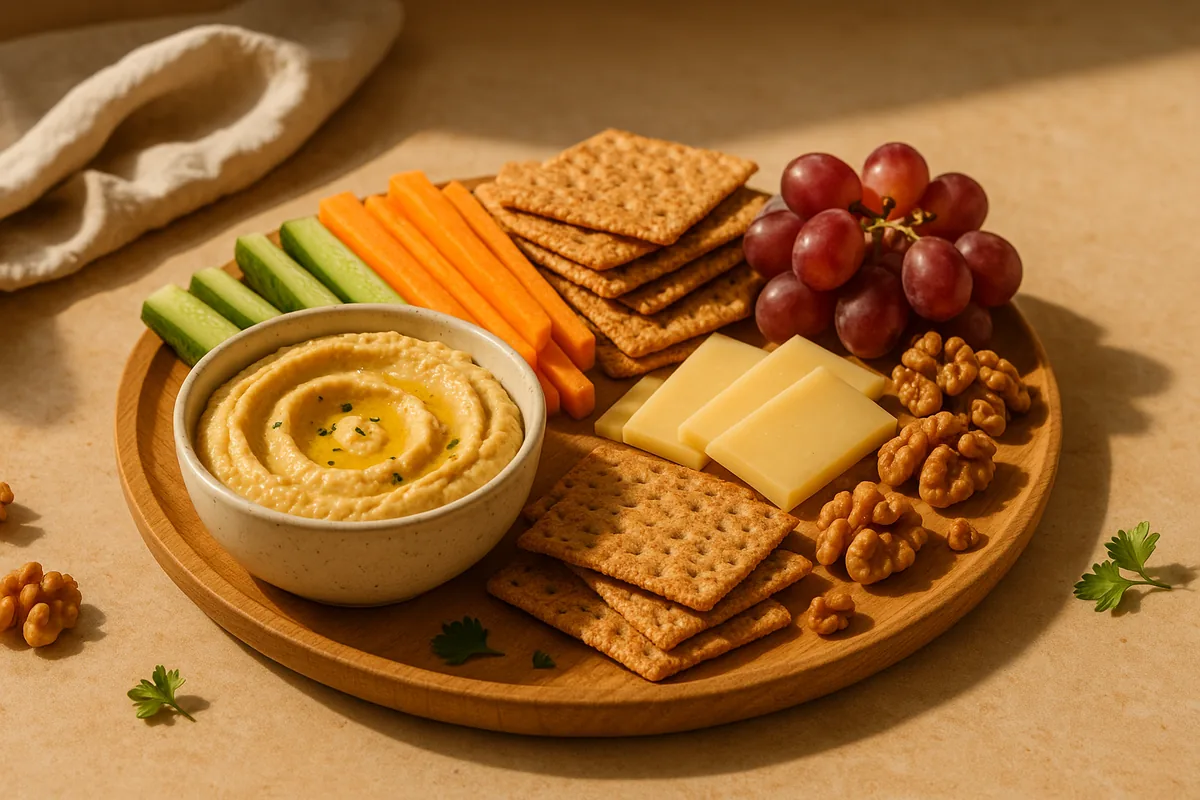
The protein food goes first. Protein is hard to reach on a small appetite, and the advisory notes that eating the protein-rich food first makes it likelier to get eaten. It points to fish, eggs, Greek yogurt, cottage cheese and nuts or nut butters as compact choices. Shakes or bars are there for people who can’t reach their target otherwise. Smoothies, cottage cheese and soups tend to appeal more than red meat, cold cuts or hard cheese. Swap inside that logic. If you’d rather cook than assemble, GLP-1 diet recipes has six small portions with the grams counted.
How much protein and fiber should the day add up to?
Protein serving goals in the 2025–2030 Dietary Guidelines for Americans run 1.2–1.6 g per kilogram of body weight a day, adjusted to individual calorie needs. The advisory also offers a fixed alternative of 80–120 g a day. I ran the range for three body weights.
| Body weight | At 1.2 g/kg | At 1.6 g/kg |
|---|---|---|
| 60 kg (132 lb) | 72 g | 96 g |
| 75 kg (165 lb) | 90 g | 120 g |
| 90 kg (198 lb) | 108 g | 144 g |
The sample day’s 115.1 g sits inside that range for anyone from 72 to 96 kg. At a higher weight it falls below the low end. Protein has a ceiling too. The acceptable range tops out at 35% of calories, which is 136 g at 1,553 kcal and 4 kcal per gram. The advisory adds that at higher body weights, actual weight can significantly overestimate protein needs. Choosing the weight is worked through in how to work out your protein grams on tirzepatide.
To get your own figure, use the protein calculator. It lets you pick 1.2, 1.4 or 1.6 g per kg of a reference weight and never gives less than 60 g.
Protein alone won’t hold on to muscle. The advisory says extra protein without structured strength training is likely inadequate. It asks for strength sessions at least 3 times a week plus at least 150 min of moderate aerobic activity.
Fiber has its own rule. The adequate intake is 14 g per 1,000 kcal, or 25 g for women and 38 g for men. At 1,553 kcal the per-energy rule gives 21.7 g, and the sample day lands at 31.3 g. The same paper puts average US intake at 17 g a day, with only 5% of people meeting the adequate intake. A jump from 17 g to 31 g is a big one. For plates that pair a legume with a protein food, see high protein high fiber meals.
Should you lower the fiber on a rough week?
That is a call for your prescriber or dietitian. The advisory says smaller, more frequent meals and avoiding fatty or high-fiber food in the first days of treatment can help with nausea. For constipation it points the other way: fluids, fiber from food, and a gradual rise in foods such as prunes or other dried fruit. If the two pull against each other for you, say so to whoever manages your treatment.
One wrinkle goes the other way. Foods high in protein or fat slow stomach emptying, the advisory says, which can worsen constipation and may call for limiting them for a while. If a protein-first day leaves you blocked, say so to your prescriber. Don’t quietly drop protein for weeks.
How much should you drink?
The label gives no volume, and neither does the advisory. The Medication Guide says diarrhea, nausea and vomiting can cause fluid loss that leads to kidney problems. It tells you to drink fluids. Nausea, vomiting or diarrhea that doesn’t go away is a reason to call your provider right away.
There is a published reference for adults in general, and it counts food too. The adequate intake for total water is 2.7 L for women and 3.7 L for men, from all foods and liquids. In the same CDC survey, plain water supplied only 34% of women’s total and 30% of men’s. The rest came from other drinks and from food.
That matters when meals shrink. I summed the Water value in the USDA records for the sample day, and the food holds about 0.96 L. Against the general reference, roughly 1.7 L for women or 2.7 L for men would have to come from drinks. This is arithmetic against a figure for adults in general, and I found no published fluid target for people on tirzepatide. Your prescriber or dietitian can tell you what applies to you.
If a doctor has limited your fluids for a kidney or heart condition, that limit wins. Alcohol is a separate question: the NHS page on tirzepatide says it’s best to avoid it because it can increase nausea and vomiting.
What do nausea, constipation and diarrhea change?
The label’s trial table shows how common they were. These are the shares of adults who reported each reaction in a pool of two weight-reduction trials, on placebo and in the three Zepbound groups.
| Reaction | Placebo | Zepbound groups |
|---|---|---|
| Nausea | 8% | 25–29% |
| Diarrhea | 8% | 19–23% |
| Vomiting | 2% | 8–13% |
| Constipation | 5% | 11–17% |
| Hair loss | 1% | 4–5% |
Most nausea, vomiting and diarrhea came during dose escalation and eased over time, the label adds. The advisory agrees that stomach effects are most likely when treatment starts or the dose goes up.
Food can help at the edges. For nausea, the advisory suggests a small breakfast, small meals every 3–4 hours, and ginger or peppermint tea. For diarrhea, it names avoiding large or high-fat meals. The fuller version of this section lives in the GLP-1 diet guide.
Some symptoms are not a food problem. The Medication Guide says to call your provider right away about severe stomach pain that won’t go away, with or without nausea or vomiting. It gives its own instructions for that case. It lists pain in the upper stomach, fever, yellowing of the skin or eyes, and clay-colored stools as possible signs of gallbladder problems. No menu answers any of those.
Hair loss deserves a second look. The label counts it among the common reactions, and the advisory lists excessive hair loss among the signs of frank nutrient deficiency. From the outside you can’t tell which one it is. Mention it to your prescriber, and don’t treat it with supplements on your own.
Can you add keto or intermittent fasting as well?
Ask first. The advisory says people on a ketogenic diet should lean on minimally processed foods and higher fiber. For people with diabetes, it adds, the combination could raise the risk of low blood sugar and ketoacidosis. Intermittent fasting can raise the risk of low blood sugar in people on diabetes medicines. On these drugs, fasting can happen by accident.
Surgery has its own rule. The label says Zepbound delays stomach emptying. Rare reports describe food still in the stomach before anesthesia or deep sedation, even after fasting as instructed. Tell every provider you take it before any planned procedure, and follow their instructions on eating beforehand, not your own.
Who should skip a template like this?
Three groups should check with a person before using a template like this.
- If you have kidney disease, your protein target is a conversation for your doctor, not a table.
- If you take insulin or a sulfonylurea, the label says the risk of low blood sugar is higher, so ask your care team before changing when or how much you eat.
- If you have a history of an eating disorder, the advisory asks for a referral to an obesity medicine specialist and an eating disorders specialist, and it calls a restrictive eating disorder a general contraindication to these drugs.
If counting calories has started to feel hard to stop, or eating feels out of control, talk to someone: ANAD in the US (1-888-375-7767), Beat in England (0808 801 0677), NEDIC in Canada (1-866-633-4220) or the Butterfly Foundation in Australia (1800 33 4673). If you’re in danger right now, call your local emergency number. Other UK numbers and crisis lines are on our crisis support page.
Start with the clock. Write down the times you ate yesterday and mark any gap over four hours. Fill the longest one with a sitting from the table, protein food first, and set an alarm for tomorrow. Check your protein against the 1.2–1.6 g/kg range once next week.
Questions and answers
What should I eat on Zepbound?
Small meals every 3–4 hours with a protein food first, such as Greek yogurt, eggs, fish or cottage cheese, plus fruit, vegetables and whole grains. That is the pattern in the 2025 joint advisory from four US professional societies. Your prescriber or a registered dietitian sets any calorie target.
What foods are easiest when nausea hits?
The advisory says smoothies, cottage cheese and soups tend to appeal more than red meat, cold cuts or hard cheese, and that ginger or peppermint tea can be beneficial. It also says vomiting is more likely with large meals, which is why the sample day keeps each sitting to 164–304 g. Nausea that is severe or won't go away is a reason to call your provider.
How much water should I drink on Zepbound?
Neither the label nor the joint advisory gives a volume. The general adult reference for total water is 2.7 L for women and 3.7 L for men, counting food and drinks together. The Medication Guide says to drink fluids and to call your provider if nausea, vomiting or diarrhea doesn't go away.
Do I have to eat on a schedule if I'm not hungry?
The advisory suggests small meals every 3–4 hours at consistent times, with an alarm or other reminder if hunger no longer tells you when. Long gaps can lead to nutrient shortfalls, and waiting until you're overly hungry can bring a rebound toward sugar and refined carbohydrates. If a schedule feels impossible, tell your prescriber.
Is hair loss a side effect of Zepbound?
Hair loss was reported by 4–5% of adults in the label's Zepbound groups against 1% on placebo. The advisory also lists excessive hair loss among signs of frank nutrient deficiency. Mention it to your prescriber instead of treating it yourself.
Sources
- Mozaffarian D, et al. Nutritional priorities to support GLP-1 therapy for obesity: a joint Advisory from the American College of Lifestyle Medicine, the American Society for Nutrition, the Obesity Medicine Association, and The Obesity Society. Am J Clin Nutr 2025, The American Journal of Clinical Nutrition
- Zepbound (tirzepatide) prescribing information and Medication Guide, DailyMed label revised 8/2026, U.S. National Library of Medicine, DailyMed
- Yogurt, Greek, plain, nonfat (Foundation, FDC ID 330137), USDA FoodData Central
- Cereals, oats, regular and quick, unenriched, cooked with water (includes boiling and microwaving), without salt (SR Legacy, FDC ID 173905), USDA FoodData Central
- Raspberries, raw (SR Legacy, FDC ID 167755), USDA FoodData Central
- Nuts, almonds (SR Legacy, FDC ID 170567), USDA FoodData Central
- Cheese, cottage, lowfat, 2% milkfat (Foundation, FDC ID 328841), USDA FoodData Central
- Pears, raw (SR Legacy, FDC ID 169118), USDA FoodData Central
- Plums, dried (prunes), uncooked (SR Legacy, FDC ID 168162), USDA FoodData Central
- Lentils, mature seeds, cooked, boiled, without salt (SR Legacy, FDC ID 172421), USDA FoodData Central
- Fish, tuna, light, canned in water, drained solids (Foundation, FDC ID 334194), USDA FoodData Central
- Spinach, cooked, boiled, drained, without salt (SR Legacy, FDC ID 168463), USDA FoodData Central
- Oil, olive, salad or cooking (SR Legacy, FDC ID 171413), USDA FoodData Central
- Egg, whole, cooked, hard-boiled (SR Legacy, FDC ID 173424), USDA FoodData Central
- Bread, whole-wheat, commercially prepared (SR Legacy, FDC ID 172688), USDA FoodData Central
- Chicken, broiler or fryers, breast, skinless, boneless, meat only, cooked, braised (Foundation, FDC ID 331960), USDA FoodData Central
- Sweet potato, cooked, baked in skin, flesh, without salt (SR Legacy, FDC ID 168483), USDA FoodData Central
- Dietary Guidelines for Americans, 2025–2030, U.S. Department of Health and Human Services and U.S. Department of Agriculture
- Wolfe RR, Cifelli AM, Kostas G, Kim IY. Optimizing Protein Intake in Adults: Interpretation and Application of the Recommended Dietary Allowance Compared with the Acceptable Macronutrient Distribution Range. Adv Nutr 2017, Advances in Nutrition
- Dahl WJ, Stewart ML. Position of the Academy of Nutrition and Dietetics: Health Implications of Dietary Fiber. J Acad Nutr Diet 2015, Journal of the Academy of Nutrition and Dietetics
- Rosinger A, Herrick K. Daily Water Intake Among U.S. Men and Women, 2009–2012. NCHS Data Brief No. 242, 2016, CDC National Center for Health Statistics
- Tirzepatide: a medicine to manage type 2 diabetes and treat obesity, NHS