2000 Calorie Meal Plan: Seven Days With Every Gram Counted
Each day of this 2000 calorie meal plan lands between 1,980 and 2,037 kcal, and the week averages 2,002 kcal with 115 g of protein. 2,000 is a label guide, not your target.
Key takeaways
- Every day of the plan lands between 1,980 and 2,037 kcal, and the week averages 2,002 kcal, 115 g of protein and 47 g of fiber.
- The FDA uses 2,000 calories a day as a general guide, and the NHS gives 2,000 kcal for an average woman and 2,500 kcal for an average man.
- The National Academies estimate 2,014 kcal for an inactive median US woman and 2,581 kcal for an inactive median US man, so 2,000 sits 581 kcal under the man's estimate.
- The 2025–2030 Dietary Guidelines set protein at 1.2–1.6 g/kg, which is 96–128 g a day at 80 kg, and all seven days of the plan fit.
- 100 g of dry brown rice is 367 kcal, and 100 g cooked is 123 kcal, so the state of the food matters more than the scale.
This 2000 calorie meal plan covers seven days with every food in grams, and each day lands between 1,980 and 2,037 kcal. The weekly average is 2,002 kcal, 115 g of protein and 47 g of fiber a day. The 2,000 comes from the FDA, which uses 2,000 calories a day as a general guide for nutrition advice. Your own number may sit higher or lower.
Is 2,000 calories a day the right amount for me?
For some adults it is. For many it isn’t. The NHS gives 2,000 kcal a day as the guide for an average woman and 2,500 kcal for an average man. It adds that the real figure moves with age, weight, height and exercise.
The National Academies give sharper numbers. Their 2023 energy report estimates the intake that holds weight steady for a person of median size at four activity levels. I pulled the rows closest to 2,000, plus the median man for contrast.
| Group (median height and weight) | Activity | Estimated need (kcal) | Gap to 2,000 (kcal) |
|---|---|---|---|
| Women 51–70 (160.8 cm, 74.8 kg) | Inactive | 1,960 | −40 |
| Women 19 and over (161.2 cm, 73.2 kg) | Inactive | 2,014 | +14 |
| Women over 70 (156.8 cm, 69.7 kg) | Active | 2,035 | +35 |
| Women 19 and over | Low active | 2,178 | +178 |
| Men over 70 (172.2 cm, 83.3 kg) | Inactive | 2,181 | +181 |
| Men 19 and over (175.4 cm, 87.2 kg) | Inactive | 2,581 | +581 |
Inactive isn’t couch-bound. Table 7-1 puts it at about 30 minutes of walking plus 90 minutes of household tasks. Low active adds 60 to 80 minutes of walking at 3 to 4 mph a day, and active adds cycling and tennis.
A woman near the first three rows could eat this plan at about her maintenance. Everyone else sits below the estimate by the gap in the last column. That gap is a calorie deficit. The man in the last row would be 581 kcal under. How big a gap suits you is a separate question, and the calorie deficit meal plan works through one.
To get an estimate from your own age, height, weight and activity, use the calorie calculator. It applies those NASEM 2023 equations and won’t set a target under the 1,200 or 1,500 calorie floors. How many calories per day shows the sum by hand. The age tables are in how many calories a woman should eat and how many calories a man should eat.
Pregnancy, breastfeeding, diabetes and kidney disease change the target. Your doctor or midwife sets it. A table on a blog can’t.
What does a 2000 calorie meal plan look like for seven days?
Four slots a day: breakfast, lunch, dinner and one snack. They come from 16 meals that repeat across the week. I worked every total from the per-100-gram values below, then added each day a second time from the meal rows.
The foods come first. Each food carries a link to its record in USDA FoodData Central, and the first column names the state: raw, boiled or dry. All 37 are Standard Reference Legacy records, a data type whose final release was April 2018, so the values won’t change on you.
Then the 16 meals, weighed in the state the first table names. Totals use the unrounded USDA values, so adding the rounded figures yourself can land a tenth off.
| Meal | Foods and grams | kcal | Protein (g) | Fiber (g) |
|---|---|---|---|---|
| B1 Oat bowl | Dry oats 50 g, 2% milk 240 g, blueberries 150 g, walnuts 20 g | 526 | 18.7 | 10.0 |
| B2 Boiled eggs on toast | Boiled eggs 100 g, whole-wheat bread 64 g, tomato 180 g, orange 180 g, 2% milk 240 g | 553 | 31.7 | 10.3 |
| B3 Yogurt, banana and oats | Greek yogurt 170 g, banana 120 g, almonds 30 g, dry oats 40 g | 532 | 30.3 | 10.9 |
| B4 Peanut butter toast and milk | Whole-wheat bread 64 g, peanut butter 32 g, banana 120 g, 2% milk 240 g | 579 | 24.3 | 8.6 |
| L1 Chicken rice bowl | Roasted chicken 120 g, cooked brown rice 120 g, boiled broccoli 150 g, carrots 130 g, olive oil 9 g, avocado 30 g | 579 | 45.9 | 12.5 |
| L2 Tuna chickpea salad | Canned tuna 100 g, boiled chickpeas 80 g, red pepper 150 g, tomato 180 g, romaine 90 g, olive oil 17 g, whole-wheat bread 32 g, avocado 50 g | 615 | 35.6 | 18.6 |
| L3 Lentil rice bowl | Boiled lentils 150 g, cooked brown rice 120 g, spinach 60 g, tomato 180 g, olive oil 9 g, cheddar 30 g, avocado 50 g | 648 | 28.0 | 20.6 |
| L4 Black bean rice bowl | Boiled black beans 150 g, cooked brown rice 100 g, avocado 70 g, tomato 180 g, cheddar 20 g, romaine 90 g | 561 | 24.7 | 23.4 |
| D1 Salmon, baked potato and broccoli | Cooked salmon 140 g, baked potato 250 g, boiled broccoli 150 g, olive oil 9 g | 653 | 40.8 | 10.4 |
| D2 Turkey tomato pasta | Ground turkey 90 g, cooked whole-wheat pasta 150 g, crushed tomatoes 240 g, spinach 60 g, olive oil 11 g | 603 | 39.0 | 11.7 |
| D3 Tofu rice and vegetables | Firm tofu 170 g, cooked brown rice 150 g, boiled broccoli 150 g, red pepper 150 g, olive oil 13 g | 636 | 38.6 | 14.4 |
| D4 Pork, sweet potato and broccoli | Roasted pork 150 g, baked sweet potato 250 g, boiled broccoli 150 g, olive oil 13 g | 607 | 47.9 | 13.2 |
| S1 Apple and peanut butter | Apple 180 g, peanut butter 24 g | 237 | 5.8 | 5.5 |
| S2 Mozzarella, orange and almonds | Mozzarella 30 g, orange 180 g, almonds 15 g | 248 | 12.2 | 6.2 |
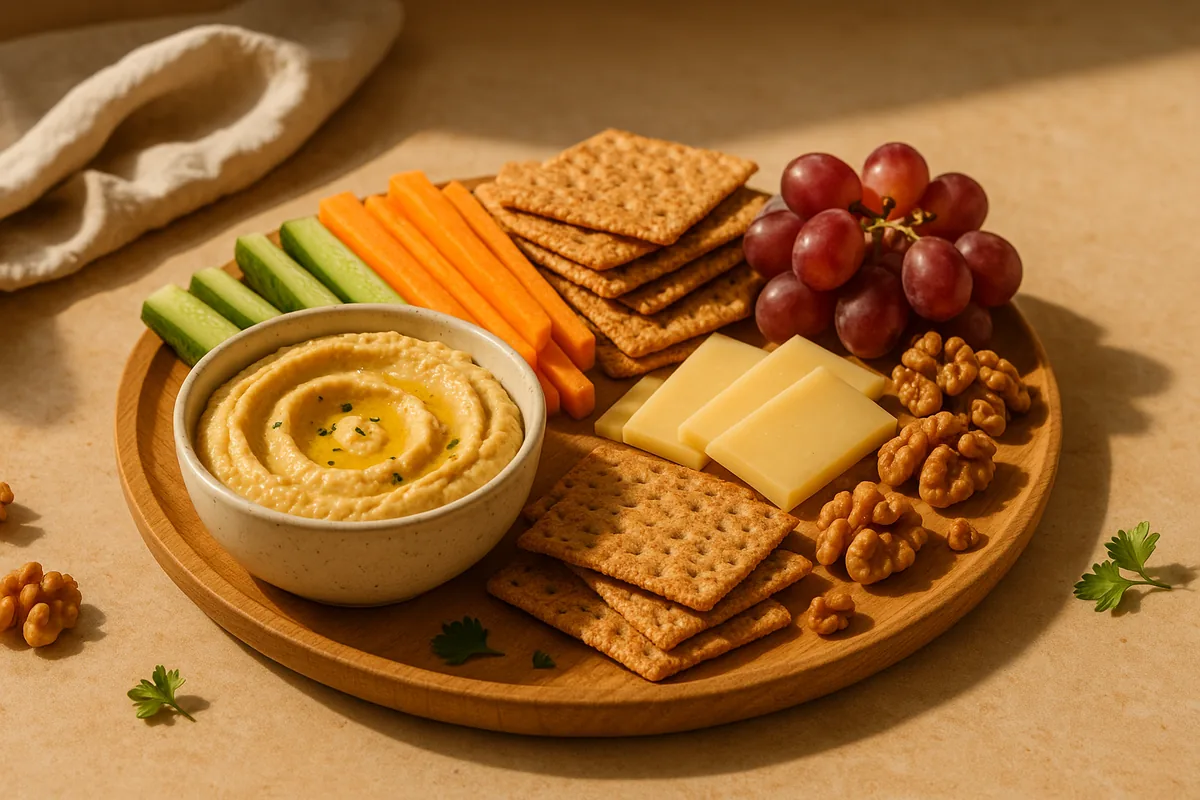
| S3 Hummus and carrots | Hummus 90 g, carrots 150 g | 221 | 5.8 | 7.8 |
| S4 Yogurt, almonds and blueberries | Greek yogurt 170 g, almonds 15 g, blueberries 80 g | 233 | 21.1 | 3.8 |
The seven days use those meals and run from 1,980 to 2,037 kcal, with 103 to 120 g of protein. The week averages 2,002 kcal across all seven days.
| Day | Breakfast | Lunch | Dinner | Snack | kcal | Protein (g) | Fiber (g) |
|---|---|---|---|---|---|---|---|
| 1 | B1 Oat bowl | L1 Chicken rice bowl | D1 Salmon, baked potato and broccoli | S1 Apple and peanut butter | 1,995 | 111 | 38 |
| 2 | B2 Boiled eggs on toast | L2 Tuna chickpea salad | D2 Turkey tomato pasta | S2 Mozzarella, orange and almonds | 2,019 | 119 | 47 |
| 3 | B3 Yogurt, banana and oats | L3 Lentil rice bowl | D3 Tofu rice and vegetables | S3 Hummus and carrots | 2,037 | 103 | 54 |
| 4 | B4 Peanut butter toast and milk | L4 Black bean rice bowl | D4 Pork, sweet potato and broccoli | S4 Yogurt, almonds and blueberries | 1,980 | 118 | 49 |
| 5 | B1 Oat bowl | L1 Chicken rice bowl | D3 Tofu rice and vegetables | S2 Mozzarella, orange and almonds | 1,989 | 115 | 43 |
| 6 | B3 Yogurt, banana and oats | L2 Tuna chickpea salad | D4 Pork, sweet potato and broccoli | S1 Apple and peanut butter | 1,991 | 120 | 48 |
| 7 | B2 Boiled eggs on toast | L4 Black bean rice bowl | D1 Salmon, baked potato and broccoli | S4 Yogurt, almonds and blueberries | 2,000 | 118 | 48 |
Brown rice appears on five days. Cook it in batches.
Does a 2,000 calorie plan meet the Dietary Guidelines?
Whole grains land inside the goal range. Fruit is just under it. Vegetables and protein foods run over, and dairy falls short. The 2025–2030 Dietary Guidelines for Americans set serving goals for a 2,000-calorie pattern. Each day that’s 3 servings of vegetables, 2 of fruit, 3 of dairy and 2 to 4 of whole grains. The USDA’s daily servings sheet adds 3 to 4 servings of protein foods and defines each serving.
| Food group | Goal at 2,000 calories | Plan, average a day | One serving on the sheet |
|---|---|---|---|
| Vegetables | 3 | 4.5 | 1 cup raw or cooked, or 2 cups of leafy greens |
| Fruits | 2 | 1.8 | 1 cup raw |
| Dairy | 3 | 1.9 | 1 cup milk, ¾ cup yogurt or 1 oz cheese |
| Whole grains | 2–4 | 3.9 | ½ cup cooked rice or oats, or 1 slice of bread |
| Protein foods | 3–4 | 5.2 | 3 oz cooked meat or fish, 1 egg, ½ cup beans, 1 oz nuts |
Cups became grams through the USDA records: a cup of chopped carrots is 128 g, a cup of milk 244 g. Yogurt counts by the 170 g container, as its record gives no cup weight. And 22 g of dry oats stands for half a cup of cooked oats, since the two carry the same calories. Whole-wheat pasta counts at half a cup cooked (58 g), and without it whole grains drop to 3.5. Beans count as protein only. The sheet lets them count as vegetables too, which would lift vegetables to 5.0. The baked potato is left out because its record has no cup weight, and the sheet names neither avocado nor hummus.
I’d rather show those gaps than bend the counts. Calories decide what fits, and a plan built on beans, fish and eggs ends up light on milk. A 240 g glass is 120 kcal, so closing the dairy gap means giving up about as much elsewhere.
Protein has its own number: 1.2–1.6 g per kilogram of body weight a day, which the Guidelines say to adjust to your calorie needs. Here it is at four body weights, with the count of days that fit.
| Body weight | 1.2 g/kg | 1.6 g/kg | Days inside the range |
|---|---|---|---|
| 60 kg (132 lb) | 72 g | 96 g | 0 of 7 |
| 70 kg (154 lb) | 84 g | 112 g | 2 of 7 |
| 80 kg (176 lb) | 96 g | 128 g | 7 of 7 |
| 90 kg (198 lb) | 108 g | 144 g | 6 of 7 |
Near 60 kg every day runs over. The overshoot is 7 to 24 g, and swapping snack S4 for S3 takes 15.3 g of protein and 12 kcal off a day. At 90 kg only day 3 falls short, by 5 g. With kidney disease, your doctor’s protein number replaces this table.
Two label figures are left. The Daily Values on US labels are 28 g of fiber and 20 g of saturated fat. Fiber is where the plan overshoots. Its days run from 38 to 54 g, well past 28 g. The Dietary Reference Intakes’ 14 g per 1,000 kcal gives the same 28 g at 2,000 kcal. Beans, oats and whole-wheat bread drive it. Swapping a bean lunch (L3 or L4) for the chicken bowl takes 8 to 11 g off a day. Saturated fat runs from 13 to 19 g a day, 6% to 9% of the day’s calories. The Guidelines say it should not exceed 10% of calories, which is 22 g at 2,000 kcal.
How do I raise or lower the plan?
Small, known pieces move a day without redoing the week. The figures below come from the same records, olive oil for one. If you want more protein than the plan gives, the high protein meal plan builds a week around it.
| Change | kcal | Protein (g) |
|---|---|---|
| Add 1 tablespoon of olive oil (13.5 g) | +119 | 0 |
| Add 1 slice of whole-wheat bread (32 g) | +81 | +4.0 |
| Add 100 g of cooked brown rice | +123 | +2.7 |
| Add 1 medium banana (118 g) | +105 | +1.3 |
| Add 15 g of almonds | +87 | +3.2 |
| Add 240 g of 2% milk | +120 | +7.9 |
| Remove snack S1 (apple and peanut butter) | −237 | −5.8 |
| Remove 1 tablespoon of olive oil (13.5 g) | −119 | 0 |
Oil and a slice of bread add 200 kcal, which lifts a day to about 2,200. If you lift and want a planned surplus, lean bulk sizes it. Dropping snack S1 from day 1 or day 6 leaves about 1,755. Both stay above the lowest figures in the AHA/ACC/TOS guideline, 1,200 kcal for women and 1,500 kcal for men on a reduced-calorie diet. I treat those as lines not to cross.
I’d trim oil and rice before touching the protein column. Oil is the cut nobody sees on the plate.
What goes wrong with a weighed meal plan?
The state of the food. A scale gives you grams, and the record you pick decides what those grams cost. Dry brown rice is 367 kcal per 100 g, and the cooked rice in the plan is 123 kcal per 100 g. The two rice records sit 244 kcal per 100 g apart, which looks like a typo and isn’t. Weigh dry rice, log it as cooked, and you record a third of what you ate.
Oil is next. The tuna salad holds 17 g of olive oil, which is 150 kcal. Pour twice that and the lunch grows by 150 kcal without looking any different.
The plan is looser than it looks. Meals in the same slot sit close together: breakfasts differ by at most 53 kcal, lunches by 87, dinners by 50 and snacks by 27. Trade one for another in the same slot and the day shifts by under 90 kcal.
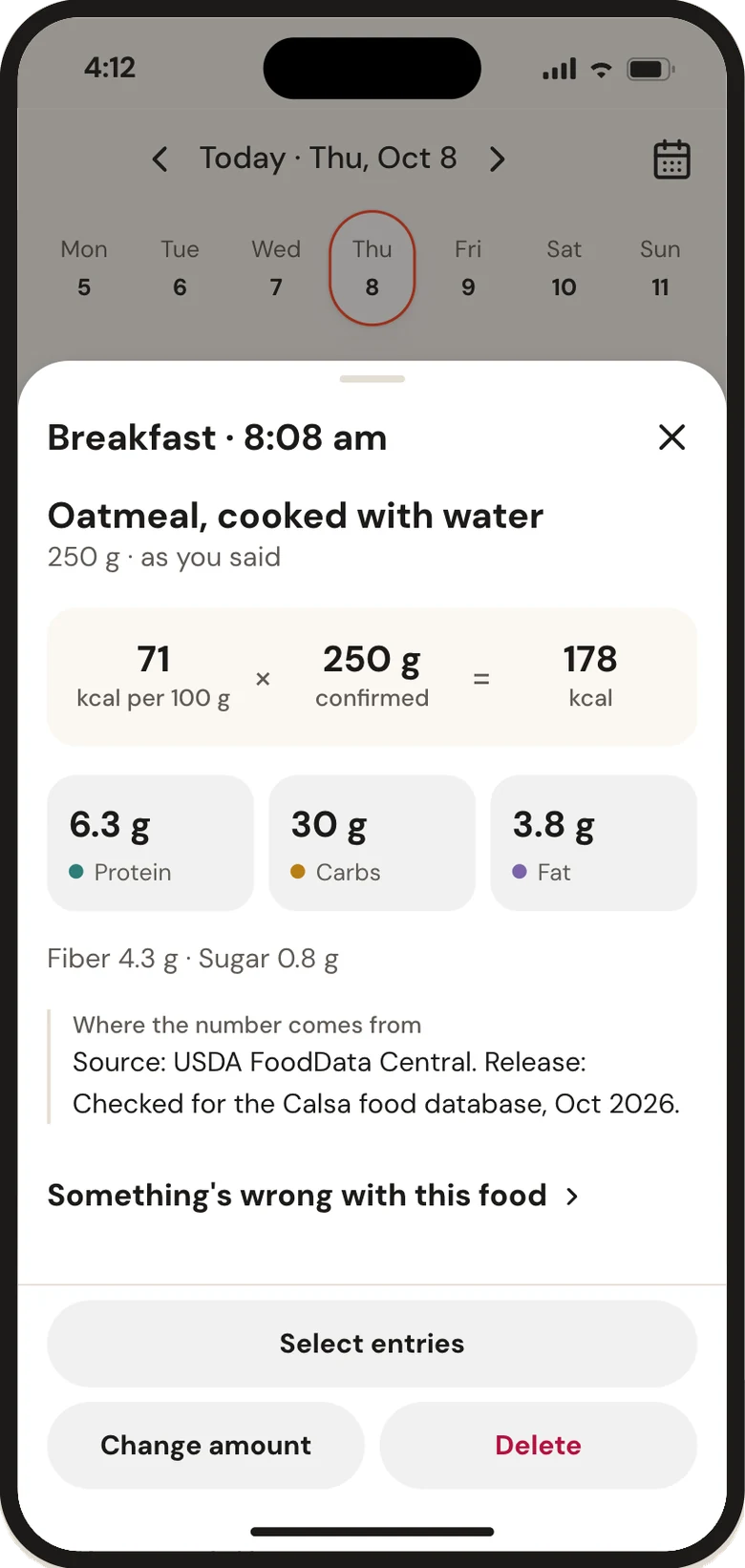
Today, weigh one breakfast. Use the oat bowl: 50 g of dry oats, 240 g of milk and 150 g of blueberries. Compare it with the bowl you’d normally pour. The difference is how far your eye is off.
Then run it as a test. Eat the plan for two weeks and weigh yourself on three mornings of each, then compare the two weekly averages instead of any single day. A steady rise or fall means your own number sits away from 2,000. After that, change one piece at a time. Start with the oil or the snack.
Questions and answers
Is 2,000 calories a day enough?
For many women, yes. The NHS gives 2,000 kcal a day as the guide for an average woman, and the National Academies estimate 2,014 kcal for an inactive median US woman. A median US man who is inactive needs about 2,581 kcal, which is 581 more, so 2,000 sits well under his estimate.
Can I follow this meal plan as a vegetarian?
Not as written. Chicken, tuna, salmon, turkey and pork appear in five of the 16 meals: L1, L2, D1, D2 and D4. Everything else is meatless but includes eggs and dairy. For 120 g of roasted chicken (198 kcal, 37.2 g of protein), 140 g of firm tofu gives 202 kcal and 24.2 g, so add yogurt or beans to close the protein gap.
How are 2,000 calories split between meals?
Unevenly, on purpose. In this plan breakfast runs from 526 to 579 kcal, lunch from 561 to 648, dinner from 603 to 653 and the snack from 221 to 248. Swap meals inside a slot and the day moves by at most 87 kcal.
Do I need a kitchen scale for this plan?
Yes, for the foods that carry the calories: oil, nuts, nut butter, rice and pasta. A tablespoon of olive oil is 13.5 g and 119 kcal, while 17 g in the tuna salad is 150 kcal. Cup measures drift, too: a cup of grated carrots is 110 g and a cup chopped is 128 g.
Sources
- Calories on the Nutrition Facts Label, U.S. Food and Drug Administration
- Understanding calories, NHS
- Dietary Reference Intakes for Energy (2023), Chapter 9: Estimated Energy Requirements, Tables 7-9 and 7-10, National Academies of Sciences, Engineering, and Medicine
- FoodData Central Data Documentation, USDA FoodData Central
- Cereals, oats, regular and quick, not fortified, dry (SR Legacy, FDC ID 173904), USDA FoodData Central
- Milk, reduced fat, fluid, 2% milkfat, with added vitamin A and vitamin D (SR Legacy, FDC ID 171267), USDA FoodData Central
- Blueberries, raw (SR Legacy, FDC ID 171711), USDA FoodData Central
- Nuts, walnuts, english (SR Legacy, FDC ID 170187), USDA FoodData Central
- Egg, whole, cooked, hard-boiled (SR Legacy, FDC ID 173424), USDA FoodData Central
- Bread, whole-wheat, commercially prepared (SR Legacy, FDC ID 172688), USDA FoodData Central
- Tomatoes, red, ripe, raw, year round average (SR Legacy, FDC ID 170457), USDA FoodData Central
- Oranges, raw, all commercial varieties (SR Legacy, FDC ID 169097), USDA FoodData Central
- Yogurt, Greek, plain, nonfat (SR Legacy, FDC ID 170894), USDA FoodData Central
- Bananas, raw (SR Legacy, FDC ID 173944), USDA FoodData Central
- Nuts, almonds (SR Legacy, FDC ID 170567), USDA FoodData Central
- Peanut butter, smooth style, without salt (SR Legacy, FDC ID 172470), USDA FoodData Central
- Chicken, broilers or fryers, breast, meat only, cooked, roasted (SR Legacy, FDC ID 171477), USDA FoodData Central
- Rice, brown, long-grain, cooked (SR Legacy, FDC ID 169704), USDA FoodData Central
- Broccoli, cooked, boiled, drained, without salt (SR Legacy, FDC ID 169967), USDA FoodData Central
- Carrots, raw (SR Legacy, FDC ID 170393), USDA FoodData Central
- Oil, olive, salad or cooking (SR Legacy, FDC ID 171413), USDA FoodData Central
- Avocados, raw, all commercial varieties (SR Legacy, FDC ID 171705), USDA FoodData Central
- Fish, tuna, light, canned in water, drained solids (SR Legacy, FDC ID 173709), USDA FoodData Central
- Chickpeas (garbanzo beans, bengal gram), mature seeds, cooked, boiled, without salt (SR Legacy, FDC ID 173757), USDA FoodData Central
- Peppers, sweet, red, raw (SR Legacy, FDC ID 170108), USDA FoodData Central
- Lettuce, cos or romaine, raw (SR Legacy, FDC ID 169247), USDA FoodData Central
- Lentils, mature seeds, cooked, boiled, without salt (SR Legacy, FDC ID 172421), USDA FoodData Central
- Spinach, raw (SR Legacy, FDC ID 168462), USDA FoodData Central
- Cheese, cheddar (SR Legacy, FDC ID 173414), USDA FoodData Central
- Beans, black, mature seeds, cooked, boiled, without salt (SR Legacy, FDC ID 173735), USDA FoodData Central
- Fish, salmon, Atlantic, farmed, cooked, dry heat (SR Legacy, FDC ID 175168), USDA FoodData Central
- Potatoes, baked, flesh and skin, without salt (SR Legacy, FDC ID 170093), USDA FoodData Central
- Turkey, ground, 93% lean, 7% fat, pan-broiled crumbles (SR Legacy, FDC ID 172851), USDA FoodData Central
- Pasta, whole-wheat, cooked (SR Legacy, FDC ID 168910), USDA FoodData Central
- Tomatoes, crushed, canned (SR Legacy, FDC ID 170501), USDA FoodData Central
- Tofu, raw, firm, prepared with calcium sulfate (SR Legacy, FDC ID 172475), USDA FoodData Central
- Pork, fresh, loin, tenderloin, separable lean only, cooked, roasted (SR Legacy, FDC ID 168250), USDA FoodData Central
- Sweet potato, cooked, baked in skin, flesh, without salt (SR Legacy, FDC ID 168483), USDA FoodData Central
- Apples, raw, with skin (SR Legacy, FDC ID 171688), USDA FoodData Central
- Cheese, mozzarella, part skim milk (SR Legacy, FDC ID 170847), USDA FoodData Central
- Hummus, home prepared (SR Legacy, FDC ID 172454), USDA FoodData Central
- Dietary Guidelines for Americans, 2025–2030, U.S. Department of Health and Human Services and U.S. Department of Agriculture
- Daily Servings by Calorie Level, 2025–2030, U.S. Department of Health and Human Services and U.S. Department of Agriculture
- Cereals, oats, regular and quick, unenriched, cooked with water (includes boiling and microwaving), without salt (SR Legacy, FDC ID 173905), USDA FoodData Central
- Daily Value on the Nutrition and Supplement Facts Labels, U.S. Food and Drug Administration
- Jensen MD, et al. 2013 AHA/ACC/TOS Guideline for the Management of Overweight and Obesity in Adults. Circulation 2014, American Heart Association, American College of Cardiology and The Obesity Society
- Rice, brown, long-grain, raw (SR Legacy, FDC ID 169703), USDA FoodData Central
- Turner ND, Lupton JR. Dietary Fiber. Advances in Nutrition 2021;12(6):2553–2555, Advances in Nutrition