Health Star Rating: What the Stars Count and What They Skip
The Health Star Rating gives packaged food ½ to 5 stars per 100 g, weighing energy, saturated fat, sugars and sodium against protein, fiber and fruit, vegetable, nut and legume content. It's voluntary and ignores your portion.
Key takeaways
- Stars come from energy, saturated fat, sugars and sodium per 100 g, offset by protein, fiber and fruit, vegetable, nut and legume content, in half-star steps from ½ to 5.
- By my hand calculation from USDA records, plain almonds score 5 stars, and a 30 g handful holds about 726 kJ, more than 25 g of dark chocolate at about 625 kJ, which scores 1.5.
- As of 5 November 2026 the system is voluntary: 39% of intended products in Australia carried a rating in November 2025, against a 70% target.
- Stars compare similar products only, so a yogurt can be set against another yogurt but not against a bag of chips.
- To count a starred food, take kJ per 100 g from the panel, weigh your portion in grams and divide kJ by 4.184 for kcal.
The Health Star Rating scores a packaged food from ½ to 5 stars in half-star steps. It sets energy, saturated fat, sugars and sodium against protein, fiber and fruit, vegetable, nut and legume content. Every input is measured on 100 g or 100 mL of the food, so the stars can’t tell you how much you ate. Australia and New Zealand introduced the system in 2014, and on 5 November 2026 it’s still voluntary.
What does the Health Star Rating count?
It counts seven things, in two groups. The calculator first looks at four components that the Health Star Rating site links to risk factors for chronic disease: energy, saturated fat, sodium and total sugars. It then offsets them with protein, fiber and the share of fruit, vegetables, nuts and legumes, which the official documents shorten to FVNL.
The figures describe the food as sold. The Implementation Guide lets a maker rate a product as prepared only when it must be rehydrated, diluted or drained and the label says so. The manufacturer does the sums with the official calculator. You can’t redo them from the panel alone, because the FVNL share is a recipe fact that the panel doesn’t carry.
Points come in steps. These are three rows of the Guide’s Table 1, which Category 2 (general foods) shares with two dairy categories. The amounts are per 100 g.
| Points | Energy (kJ) | Saturated fat (g) | Total sugars (g) | Sodium (mg) |
|---|---|---|---|---|
| 1 point above | 335 | 1.0 | 5.0 | 90 |
| 5 points above | 1,675 | 5.0 | 20.7 | 450 |
| 10 points above | 3,350 | 10.0 | 40.3 | 900 |
Energy gains a point for every 335 kJ, which is about 80 kcal (335 ÷ 4.184). Sugars start to score at 5 g per 100 g, so that first step is a food that is 5% sugar by weight. Sodium starts at 90 mg.
Against those baseline points, a general food can earn up to 8 points for FVNL, 15 for protein and 15 for fiber. Protein has a condition: it scores only when the baseline points are under 13 or the FVNL points reach 5. The system sorts foods into six categories, such as non-dairy drinks, dairy drinks, general foods, dairy foods, oils and spreads, and cheese. Each one has its own tables.
How does a score turn into stars?
You subtract the modifying points from the baseline points, then read the result against the table for the category. A lower score earns more stars. This is the Category 2 table from the Guide.
| Final score | Stars |
|---|---|
| −11 or lower | 5 |
| −10 to −7 | 4.5 |
| −6 to −2 | 4 |
| −1 to 2 | 3.5 |
| 3 to 6 | 3 |
| 7 to 11 | 2.5 |
| 12 to 15 | 2 |
| 16 to 20 | 1.5 |
| 21 to 24 | 1 |
| 25 or higher | 0.5 |
I ran the Guide’s tables by hand on four records from USDA’s SR Legacy set, each per 100 g. They are oats, regular and quick, dry, almonds, dark seedless raisins, and dark chocolate, 70–85% cacao.
| Food | Energy | Saturated fat | Sugars | Sodium | Baseline points | Modifying points | Score | Stars |
|---|---|---|---|---|---|---|---|---|
| Oats, dry | 1,590 kJ | 1.11 g | 0.99 g | 6 mg | 5 | 17 | −12 | 5 |
| Almonds | 2,420 kJ | 3.8 g | 4.35 g | 1 mg | 10 | 29 | −19 | 5 |
| Raisins | 1,250 kJ | 0.094 g | 65.2 g | 26 mg | 19 | 14 | 5 | 3 |
| Dark chocolate | 2,500 kJ | 24.5 g | 24.0 g | 20 mg | 30 | 10 | 20 | 1.5 |
Take the oats. Energy of 1,590 kJ is above 1,340, so 4 points. Saturated fat of 1.11 g clears the first step at 1.0 g for 1 point. Sugars and sodium score nothing. Five baseline points. Oats are a cereal grain, and the Guide bars cereal grains from FVNL points, so those are 0. Protein of 13.2 g is above 11.6 g for 7 points, and fiber of 10.1 g is above 9.7 g for 10. The sum is 5 − 7 − 10 = −12, below the −11 line for 5 stars.
The other three go the same way. Plain shelled almonds count as 100% nuts, which earns 8 FVNL points, plus 10 for protein and 11 for fiber. Raisins are 100% dried fruit, which the Guide scores as concentrated fruit, again 8 points, then 2 for protein and 4 for fiber. The chocolate’s baseline of 30 and its lack of FVNL shut protein out. Its 7.79 g would otherwise be worth 4 points, and only the fiber’s 10 points pull the score down to 20.
Thresholds are sharp. 1.0 g of saturated fat scores nothing and 1.1 g scores a point, and the oats sit just over that edge. It changes nothing for them, since −13 and −12 both clear the 5-star line. For a food near a cut-off, one point moves the stars. The Guide says its manual tables let makers see the cut-offs and reformulate; a curious reader can use them to see where the points fall.
These are exercises, not ratings of anything on a shelf. A real pack has its own recipe, and the maker’s declared values decide its stars.
Can you compare any two foods by their stars?
Only similar ones. That is the site’s own rule. Its own example: a yogurt can be set against another yogurt, never against a bag of chips. The reason sits in the tables above. Each category converts scores into stars on its own scale, and the site notes that a soft drink is calculated differently from a yogurt.
The raisins are the surprise. They carry 65.2 g of sugars per 100 g and still land on 3 stars. I rechecked the sugar row: 65.2 g is above 63.8 g, so the sugar alone costs 16 baseline points. FVNL, protein and fiber then hand back 14. The input is total sugars, which is the line on your panel. It doesn’t separate sugar added to a recipe from the sugar that comes with the fruit or milk in it. The site tells shoppers the same thing. A product higher in total sugars can still rate well if it has less saturated fat or energy, or more protein, fiber or FVNL.
Some products never carry stars. The Guide lists infant formula, foods for infants, products above 0.5% alcohol by volume and kava among the foods that must not show the graphic. Unpackaged foods and foods without a panel may show it, but nobody expects them to. Fresh produce stands outside the arithmetic. The Guide makes packaged fresh and minimally processed fruit and vegetables, and plain water, eligible to show 5 stars. The Guide calls that a policy decision and says a calculated rating for some of these foods might not line up with the dietary guidelines.
Researchers have also tested how the stars behave on real products. A 2018 study by Dickie, Woods and Lawrence covered 1,269 new packaged products. Each carried a rating when released in Australia between 27 June 2014 and 30 June 2017. Ultra-processed products had a median of 3.5 stars, against 4.5 for minimally processed ones, and 76.9% of the ultra-processed products scored 2.5 or more. The authors suggested that the algorithm may penalize added sugar too little, and proposed scoring added sugar instead of total sugars. The products are old, so I can’t say how 2026 launches would fare.
The site adds two limits of its own. The system doesn’t consider vitamins and minerals, and it doesn’t replace advice from a dietitian.
Is the Health Star Rating mandatory?
No. The Health Star Rating site says on its proposal page that the system remains voluntary. Makers and retailers can adopt or drop it at any stage, so a missing star proves nothing about a product.
Food Ministers set uptake targets for products that are meant to carry a rating. The uptake reports show how far the shelf got.
| Target date | Target | Australia, measured | New Zealand, measured |
|---|---|---|---|
| 14 November 2023 | 50% | 32% | 30% |
| 14 November 2024 | 60% | 35% | 33% |
| 14 November 2025 | 70% | 39% | 36% |
On 13 February 2026 Food Ministers asked Food Standards Australia New Zealand (FSANZ) to draft a proposal to mandate the system. The final target had been missed. FSANZ is now working on it as Proposal P1067. The second call for submissions on that work runs from 28 October to 23 December 2026. The proposed approach would put the symbol on most packaged foods that need a nutrition information panel, with listed exemptions and prohibitions. It would also standardise the symbol’s design and location and require the rating to come from a prescribed algorithm. FSANZ also proposes a transition of at least 3 years, so labels won’t change overnight even if ministers agree.
Nothing in it is law yet. Check the proposal page before you rely on any date.
What do the stars skip when you’re counting?
Your portion. The Guide says the system isn’t designed to tell anyone how much of a product to eat. The star element is always worked out per 100 g or 100 mL, even when the energy icon on the pack shows kJ per serve. The serve size is the business’s choice, so two similar products can list different serves.
Here is what that does to the kJ. The serves below are my picks. The exception is the 25 g for chocolate, which the Guide lists as the industry-agreed serve for confectionery (25 g, give or take 5).
| Food | Stars (my calculation) | Serve | Energy in the serve |
|---|---|---|---|
| Almonds | 5 | 30 g | 726 kJ (174 kcal) |
| Dark chocolate | 1.5 | 25 g | 625 kJ (149 kcal) |
| Oats, dry | 5 | 40 g | 636 kJ (152 kcal) |
| Raisins | 3 | 30 g | 375 kJ (90 kcal) |
A 30 g serve of 5-star almonds holds more kJ than a 25 g serve of 1.5-star chocolate. That isn’t a contradiction, because the stars compare similar packs per 100 g and say nothing about serves. The kJ are what you log.
The energy icon can also show a percent daily intake. That rests on a reference of 8,700 kJ for an average adult, or about 2,079 kcal. That’s a fixed reference printed on the pack. Your own daily figure depends on your body and activity, and how many kilojoules an adult needs a day works it through.
If you manage diabetes or kidney disease, your sugar, protein and sodium targets come from your doctor, not from a star count.
How do you log a starred food in a diary?
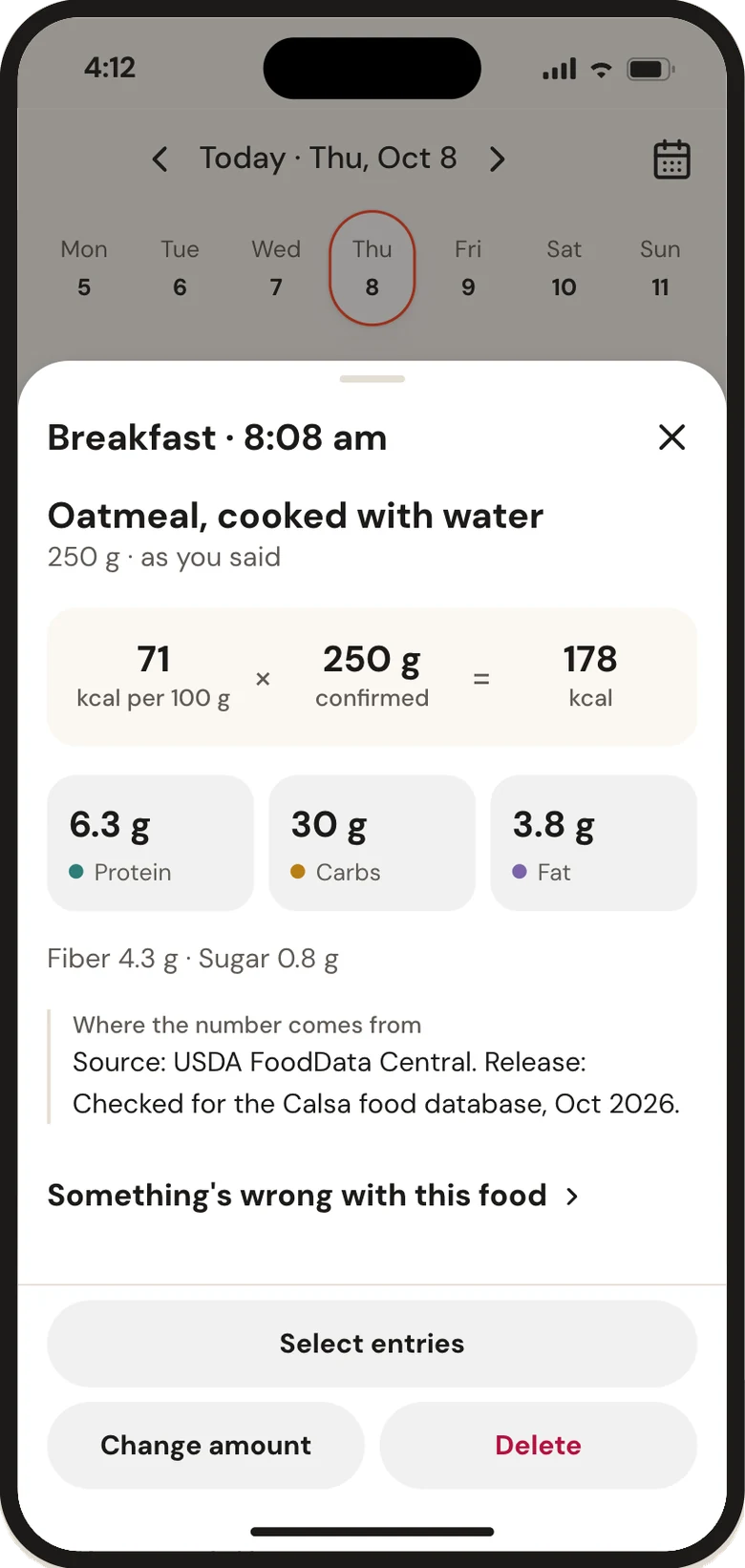
Ignore the stars and use the panel. The panel is covered in how to read a nutrition label.
- Find the energy line in the per 100 g column.
- Weigh what ends up in your bowl, in grams, using the method in how to weigh food for macros.
- Multiply: kJ per 100 g × grams ÷ 100.
- Divide by 4.184 if your diary counts kcal.
Say a pack of oats prints 1,590 kJ per 100 g, the figure in the USDA oats record, and you eat 55 g. The sum is 1,590 × 55 ÷ 100 = 874.5 kJ, or about 209 kcal.
Now the case the serve column hides. Suppose a pack of almonds lists a 30 g serve at 726 kJ, and you pour 45 g. The energy is 2,420 × 45 ÷ 100 = 1,089 kJ, about 260 kcal. The serve column is correct for 30 g, and you ate 45. To check a panel figure in either unit, use the kJ to Calories converter; it applies the 4.184 factor and converts both ways.
A Calorie figure printed on the pack can sit a little away from your own conversion. Reading an Australian label explains why. Weigh the food in the state the column describes, dry or cooked, as sold or as prepared. Apps differ in how well they handle kJ, and counting calories in Australia lists the checks to run.
Try this on your next shop. Pick two products from one aisle and write down their stars and their kJ per 100 g side by side. Then weigh one serve of the pack you choose, and compare those grams with the serve printed on its panel.
Questions and answers
Is the Health Star Rating compulsory in Australia?
No. As of 5 November 2026 the system is voluntary, and 39% of intended products in Australia showed a rating in November 2025 against a 70% target. FSANZ has a proposal to mandate it, with a second call for submissions open from 28 October to 23 December 2026 and a proposed transition of at least 3 years.
Are Health Star Ratings worked out per serve or per 100 g?
Per 100 g or 100 mL of the food as sold. The energy icon on a pack may show kJ per serve, but the star element is still calculated per 100 g or 100 mL, so a bigger serve changes your kJ and leaves the stars alone.
Can a food high in sugar get a high Health Star Rating?
Yes, because protein, fiber and fruit, vegetable, nut and legume content subtract points. By my calculation, dark seedless raisins with 65.2 g of sugars per 100 g score 19 baseline points and 14 modifying points, a final score of 5, which is 3 stars.
How do I convert the kilojoules on a starred food to calories?
Divide kJ by 4.184. A panel with 1,590 kJ per 100 g is about 380 kcal per 100 g, and 55 g of that food is about 209 kcal. A Calorie figure printed on the pack can differ from your sum by a calorie or so.
Do fresh fruit and vegetables get a Health Star Rating?
They can. The Implementation Guide makes packaged fresh and minimally processed fruit and vegetables eligible for 5 stars, but fruit and vegetables sold loose are not packaged and may show none. The Guide doesn't count those products as intended ones when uptake is monitored.
Sources
- How ratings are calculated, Health Star Rating System
- About the Health Star Rating system, Health Star Rating System
- For shoppers: how it works and frequently asked questions, Health Star Rating System
- Health Star Rating System Implementation Guide, version 9.1, Health Star Rating System
- Cereals, oats, regular and quick, not fortified, dry (SR Legacy, FDC ID 173904), USDA FoodData Central
- Nuts, almonds (SR Legacy, FDC ID 170567), USDA FoodData Central
- Raisins, dark, seedless (SR Legacy, FDC ID 168165), USDA FoodData Central
- Chocolate, dark, 70-85% cacao solids (SR Legacy, FDC ID 170273), USDA FoodData Central
- Dickie S, Woods JL, Lawrence M. Analysing the use of the Australian Health Star Rating system by level of food processing. Int J Behav Nutr Phys Act 2018, International Journal of Behavioral Nutrition and Physical Activity
- Proposal on mandating the HSR system, Health Star Rating System
- Uptake reports and targets, Health Star Rating System
- P1067 - Health Star Rating System, Food Standards Australia New Zealand
- Nutrition information panels, Food Standards Australia New Zealand