How Much Fiber Per Day? A Gram Count in Real Foods
US adults aged 19 to 50 should aim for 25 g of fiber a day if female and 38 g if male, or 14 g per 1,000 kcal. The UK target is 30 g.
Key takeaways
- The US Adequate Intake for fiber is 14 g per 1,000 kcal, or 25 g for women and 38 g for men aged 19 to 50. The UK target is 30 g.
- Average US intake was 16 g a day in NHANES 2009–2010, and a 2015 position paper says only 5% of Americans reach the Adequate Intake.
- 5 g of fiber is 63 g of boiled lentils (73 kcal) or 77 g of raspberries (40 kcal). The same 5 g from almonds costs 232 kcal.
- A 2019 Lancet review found the greatest risk reduction at 25 to 29 g of fiber a day, mostly from observational studies.
- With fiber at 2 kcal a gram, as on UK labels, USDA's lentil record sums to 104 kcal per 100 g, against 120 kcal at 4 kcal a gram.
Adults aged 19 to 50 in the US should aim for 25 g of fiber a day if female and 38 g if male. That is 14 g for every 1,000 kcal eaten. UK adults get one figure, 30 g, and Australia sets 25 g for women and 30 g for men. The US, UK and Australian figures each link to the page I read, and the survey numbers below show most adults land under them. I worked each target into grams of real food and rechecked every row by hand.
How much fiber per day do adults need?
The US target is an Adequate Intake of 14 g per 1,000 kcal. Multiplied by median calorie intakes, that becomes 25 g for women and 38 g for men aged 19 to 50. Health Canada’s table lists the same values, plus 21 g for women and 30 g for men from age 51. The USDA’s glossary calls an Adequate Intake a daily average assumed to be enough. It isn’t a pass mark.
| Country | Adult target per day | What it is |
|---|---|---|
| US | Women 25 g, men 38 g (ages 19–50); 21 g and 30 g after 50 | Adequate Intake, built on 14 g per 1,000 kcal |
| Canada | Same as the US | Adequate Intake |
| UK | 30 g | Government recommendation, from the 2015 SACN report |
| Australia | Women 25 g, men 30 g | Adequate Intake, based on laxation (bowel regularity) |
Australia also lists a higher target for lowering the risk of chronic disease. That Suggested Dietary Target is 28 g for women and 38 g for men, one analysis of its national survey reports. The UK figure is the government’s 2016 summary of the Scientific Advisory Committee on Nutrition’s 2015 report. If you’re pregnant, breastfeeding or under a doctor’s care, your number is a question for them.
Where do the targets come from?
The US figure rests on heart disease. The Academy of Nutrition and Dietetics says the US figure comes from research showing protection against coronary heart disease. The largest check since is a 2019 Lancet review by Reynolds and colleagues. It pooled 185 prospective studies and 58 trials, just under 135 million person-years of data.
Observational data compared the highest fiber eaters with the lowest. It showed 15 to 30% lower all-cause and cardiovascular mortality, and lower rates of coronary heart disease, stroke, type 2 diabetes and colorectal cancer. The reduction was greatest at 25 to 29 g a day. The curves hinted at more benefit above that. That fits the view that eating more fiber may help to reduce the risk of these conditions.
Read that with its limits. Most of the evidence is observational, and people who eat more fiber differ in other ways too. The authors restricted their findings to people without chronic disease and excluded weight-loss and supplement trials. The abstract gives a range, 25 to 29 g, and no figure that separates 27 g from 24 g. Treat 25 as a marker, not a cliff.
How much fiber do people actually eat?
Less than the targets. A USDA brief on NHANES 2009–2010 put average US intake at 16 g a day: 18 g for males and 15 g for females. The Academy’s 2015 position paper gives a US mean of 17 g, with only 5% of people reaching the Adequate Intake.
Australia is similar. In its 2011–12 survey the median adult ate 20.7 g, 28.2% of adults met the Adequate Intake, and under 20% met the higher target. In the UK’s national diet survey for 2016 to 2019, adults aged 19 to 64 averaged 19.7 g, and 9% reached 30 g. The NHS says most adults eat about 20 g.
Surveys differ in year, method and who got counted, so treat these as ballpark figures and not exact comparisons between countries. The direction is clear, though. Take the US averages against the targets: the gap is 10 g for the average woman (15 against 25) and 20 g for the average man (18 against 38). The question is how to add fiber, not how to cap it.
Should I use the grams or the 14 g per 1,000 kcal rule?
The grams for your sex and age are the simpler start. The calorie rule matters if you eat far more or less than average, because the grams assume a typical intake. A footnote in Health Canada’s table says the grams come from that rule. The 14 g per 1,000 kcal is multiplied by each group’s median energy intake, so the two are one idea at different calorie levels.
| Daily calories | Fiber at 14 g per 1,000 kcal |
|---|---|
| 1,500 kcal | 21.0 g |
| 1,800 kcal | 25.2 g |
| 2,000 kcal | 28.0 g |
| 2,500 kcal | 35.0 g |
| 3,000 kcal | 42.0 g |
I multiplied each calorie figure by 14 and divided by 1,000. At 1,800 kcal the rule lands on the women’s 25 g. At 2,500 kcal it gives 35 g, short of the men’s 38 g, which would need about 2,700 kcal (38 ÷ 14 × 1,000). Someone eating 1,500 kcal gets 21 g from the rule, under the 25 g figure. For scale, 25 g of fiber from boiled lentils costs about 370 kcal (25 × 14.7, from the table below).
The macro calculator splits a daily calorie goal into protein, fat and carbs. It also shows a fiber line of at least 14 g per 1,000 kcal, the rule in the table above. Fiber belongs to carbohydrate, and what macros are shows how the three fit together.
What does 5 g of fiber look like in real foods?
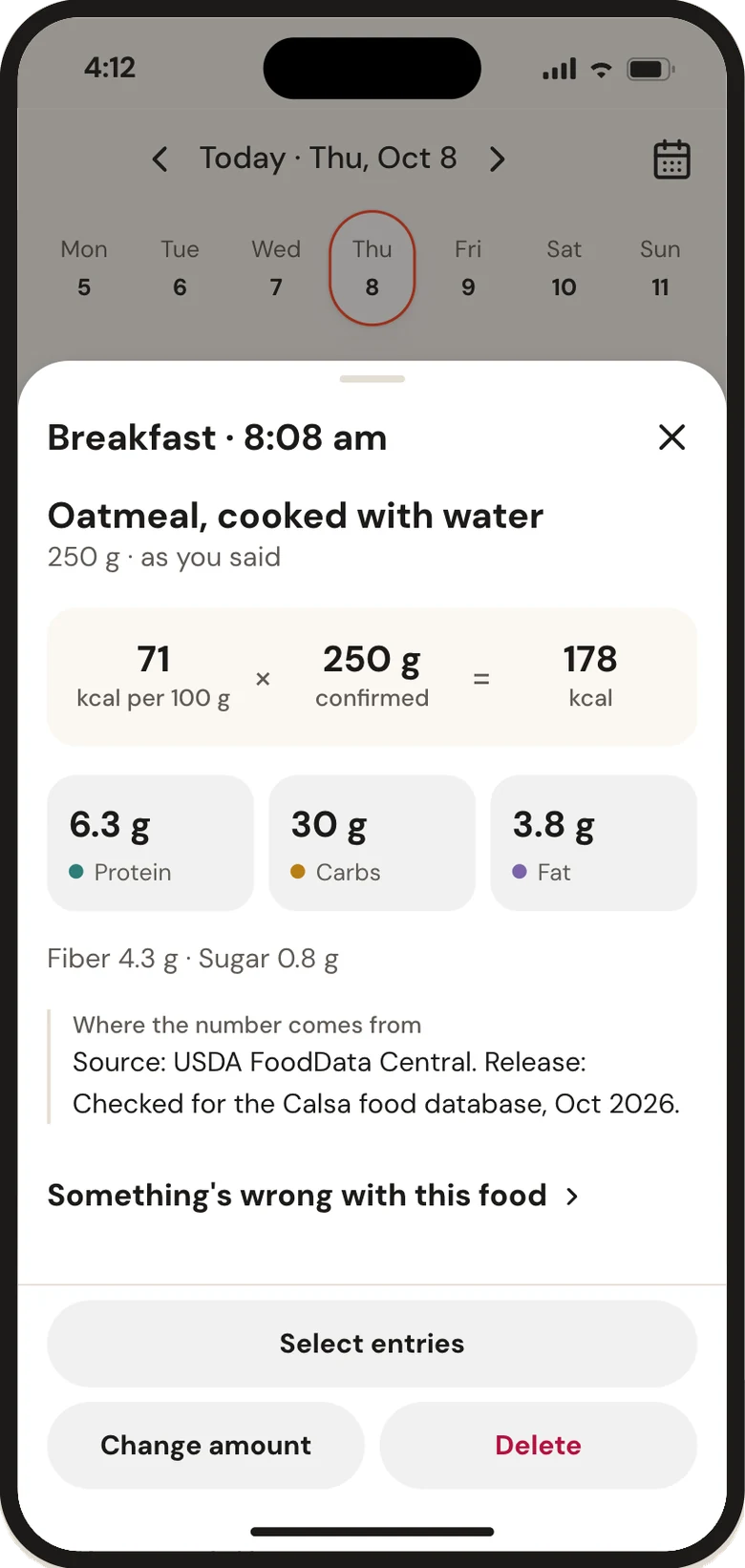
Five grams is a handy unit, because a day at 25 to 30 g is five or six of them. Each food below is weighed out to 5 g of fiber, then priced in calories, and every value comes from a USDA FoodData Central SR Legacy record, like this one for lentils. Amounts are per 100 g, in the state named. I sorted the rows by calories per gram of fiber, cheapest first.
| Food (USDA record) | Fiber per 100 g | Grams of food for 5 g fiber | kcal in that portion | kcal per 1 g of fiber |
|---|---|---|---|---|
| Raspberries, raw | 6.5 g | 77 g | 40 | 8.0 |
| Broccoli, boiled | 3.3 g | 152 g | 53 | 10.6 |
| Chia seeds, dried | 34.4 g | 15 g | 71 | 14.1 |
| Lentils, boiled | 7.9 g | 63 g | 73 | 14.7 |
| Black beans, boiled | 8.7 g | 58 g | 76 | 15.2 |
| Pear, raw | 3.1 g | 161 g | 92 | 18.4 |
| Chickpeas, boiled | 7.6 g | 66 g | 108 | 21.6 |
| Apple, raw, with skin | 2.4 g | 208 g | 108 | 21.7 |
| Avocado, raw | 6.7 g | 75 g | 119 | 23.9 |
| Oats, dry | 10.1 g | 50 g | 188 | 37.5 |
| Whole-wheat bread | 6.0 g | 83 g | 210 | 42.0 |
| Almonds | 12.5 g | 40 g | 232 | 46.3 |
For each row, divide 500 by the fiber per 100 g, then multiply those grams by the record’s calories per 100 g. For lentils, 500 ÷ 7.9 = 63.3 g, and 63.3 × 1.16 = 73 kcal. Grams and calories are rounded at the end, not before.
Raspberries, broccoli, chia, lentils and black beans cost 8 to 15 kcal per gram of fiber. Oats, whole-wheat bread and almonds cost 37 to 46. The gap is wider than I expected: almonds cost nearly six times as many calories per gram of fiber as raspberries, 46.3 against 8.0. It matters most when your calorie budget is tight. Beans and lentils also carry protein, and high protein beans ranks them by the cup. Four complete plates are in high protein high fiber meals.
Two cautions. The oats row is the dry weight. Log dry grams, not cooked porridge. And a USDA record is an average. The raspberry record rests on 13 samples that ranged from 4.1 to 8.2 g per 100 g. Your punnet can land either side of 6.5.
What does a 30 g day look like?
About 29 g, from six foods. Each weight is read against its USDA record, such as dry oats or boiled lentils. I chose round gram weights so the sums stay checkable on a kitchen scale.
| Meal | Food and weight | Fiber | kcal |
|---|---|---|---|
| Breakfast | Dry oats, 40 g | 4.0 g | 152 |
| Breakfast | Raspberries, 100 g | 6.5 g | 52 |
| Lunch | Whole-wheat bread, 75 g | 4.5 g | 189 |
| Lunch | Boiled lentils, 100 g | 7.9 g | 116 |
| Dinner | Boiled broccoli, 100 g | 3.3 g | 35 |
| Snack | Raw pear, 100 g | 3.1 g | 57 |
| Total | 29.3 g | 601 |
Breakfast gives 10.5 g and lunch 12.4 g. Dinner and the snack add the last 6.4 g. The six foods carry about 49 g of fiber per 1,000 kcal, which leaves most of a 1,800 kcal day for everything else. The total clears the women’s 25 g and sits just under the UK’s 30 g. Add 25 g of almonds and the day passes 32 g. Multiply every weight by 1.3 and it reaches about 38 g, the men’s figure (29.3 × 1.3 = 38.1), at roughly 780 kcal.
This is one possible shape. Swap lentils for chickpeas or bread for oats and the totals move, but it’s the same sum. Pick what you already eat and read its grams off the table.
Does fiber count as calories?
It depends on the labeling rule. In a simple 4-9-4 sum, fiber sits inside carbohydrate and counts 4 kcal a gram, but on a UK pack the law counts it at 2. The UK version of EU labeling law lists fiber at 8 kJ/g, or 2 kcal/g. The Australia New Zealand Food Standards Code gives dietary fiber the same 8 kJ/g. Calories per gram of protein, carbs and fat covers the split.
Here’s what that does to lentils. USDA’s lentil record lists 9.02 g of protein, 0.38 g of fat, 20.1 g of carbohydrate and 7.9 g of fiber per 100 g. The plain sum is 9.02 × 4 + 0.38 × 9 + 20.1 × 4 = 119.9 kcal. With fiber at 2 kcal a gram, it’s (20.1 − 7.9) × 4 + 9.02 × 4 + 0.38 × 9 + 7.9 × 2 = 104.1 kcal. The record itself says 116. The three answers sit within 16 kcal of each other.
Over a day with 30 g of fiber, the two methods differ by 60 kcal (30 × 2). That’s small next to a portion error. Pick the entry that matches your country’s label. Then stay with it. What a calorie is explains why labels count fiber differently.
A few label numbers help too. The FDA’s Daily Value for fiber is 28 g, and 20% DV or more per serving counts as high, which is 5.6 g. Canada’s table of Daily Values also lists 28 g for adults. In the UK, the nutrition-claims rule kept from EU law sets “high in fiber” at 6 g or more per 100 g. The alternative test is 3 g per 100 kcal. The whole-wheat bread record in the table sits exactly on the 6 g line (6.0 g per 100 g).
How fast should I add fiber, and what if it causes gas?
Slowly. The US NIDDK says to add fiber a little at a time so the body gets used to the change. It also says to drink water and other liquids.
No grams-per-week rule appears there, and no health body I opened gives one. So I won’t invent one. Here’s what I’d do. Add one 5 g row from the table to the food you already eat and hold it for a week. Then add another. A jump from 15 g to 35 g in one day is the opposite of a little at a time.
Some conditions change the answer. If you have a bowel condition or kidney disease, your target is for your doctor and not for a table. Follow a low-fiber diet if a doctor has asked for one. Gas that comes with pain is another reason to ask.
What can I change today?
Pull up your last three days of food and add up the fiber in each. Divide it by that day’s kcal and multiply by 1,000: 18 g on 2,000 kcal is 9 g per 1,000 kcal. If yours is under the 14 g rule, pick the cheapest row in the table that you’d eat anyway. Add 5 g of it tomorrow.
Questions and answers
How much fiber should a woman eat a day?
A woman aged 19 to 50 should aim for 25 g a day in the US, Canada and Australia, and 21 g from age 51 in the US and Canada. The UK gives all adults 30 g. In pregnancy or breastfeeding, ask your midwife or doctor which number applies.
How much fiber should a man eat a day?
A man aged 19 to 50 should aim for 38 g a day in the US and Canada, and 30 g from age 51. The UK target is 30 g for all adults, and Australia's Adequate Intake is 30 g. Australia also lists a higher target of 38 g for lowering the risk of chronic disease.
How fast should I increase my fiber?
A little at a time. The NIDDK advises adding fiber gradually so your body gets used to it, and drinking water and other liquids. It gives no grams-per-week figure, so one extra 5 g portion of food a week is a pace of my own. With a bowel condition or kidney disease, ask your doctor first.
How many grams of lentils give 10 g of fiber?
About 127 g of boiled lentils, which is 147 kcal. USDA lists 7.9 g of fiber and 116 kcal per 100 g, so 10 ÷ 7.9 × 100 = 127 g, and 127 × 1.16 = 147 kcal. Raspberries need about 154 g for the same 10 g.
Does fiber have calories?
Yes. UK labeling law counts it at 2 kcal a gram and the Australian code at 8 kJ (about 2 kcal), while a simple 4-9-4 sum counts it at 4. At 30 g of fiber a day the two methods differ by 60 kcal. Pick the entry that matches your country's label and keep using it.
Sources
- Position of the Academy of Nutrition and Dietetics: Health Implications of Dietary Fiber (Dahl and Stewart, J Acad Nutr Diet 2015), PubMed
- Government Dietary Recommendations: energy and nutrients for males and females aged 1-18 years and 19+ years (2016), Public Health England
- Dietary Fibre Intake in Australia. Paper I (Fayet-Moore et al., Nutrients 2018), PubMed Central
- Dietary reference intakes tables: Reference values for macronutrients, Health Canada
- Dietary Fiber Intake of the U.S. Population, What We Eat in America, NHANES 2009-2010 (Dietary Data Brief No. 12), USDA Agricultural Research Service
- National Diet and Nutrition Survey, results from years 9 to 11 (2016 to 2017 and 2018 to 2019): combined statistical summary, GOV.UK
- How to get more fiber into your diet (NHS), NHS
- Carbohydrate quality and human health: a series of systematic reviews and meta-analyses (Reynolds et al., Lancet 2019), PubMed
- Lentils, mature seeds, cooked, boiled, without salt (SR Legacy, FDC ID 172421), USDA FoodData Central
- Raspberries, raw (SR Legacy, FDC ID 167755), USDA FoodData Central
- Broccoli, cooked, boiled, drained, without salt (SR Legacy, FDC ID 169967), USDA FoodData Central
- Seeds, chia seeds, dried (SR Legacy, FDC ID 170554), USDA FoodData Central
- Beans, black, mature seeds, cooked, boiled, without salt (SR Legacy, FDC ID 173735), USDA FoodData Central
- Pears, raw (SR Legacy, FDC ID 169118), USDA FoodData Central
- Chickpeas (garbanzo beans, bengal gram), mature seeds, cooked, boiled, without salt (SR Legacy, FDC ID 173757), USDA FoodData Central
- Apples, raw, with skin (SR Legacy, FDC ID 171688), USDA FoodData Central
- Avocados, raw, all commercial varieties (SR Legacy, FDC ID 171705), USDA FoodData Central
- Cereals, oats, regular and quick, not fortified, dry (SR Legacy, FDC ID 173904), USDA FoodData Central
- Bread, whole-wheat, commercially prepared (SR Legacy, FDC ID 172688), USDA FoodData Central
- Nuts, almonds (SR Legacy, FDC ID 170567), USDA FoodData Central
- Regulation (EU) No 1169/2011, Annex XIV: conversion factors for calculating energy (UK version), legislation.gov.uk
- Australia New Zealand Food Standards Code, Schedule 11, energy factors (section S11-2), current compilation F2024C01138, Australian Government, Federal Register of Legislation
- Daily Value on the Nutrition and Supplement Facts Labels, U.S. Food and Drug Administration
- Table of Daily Values: nutrition labelling (Part 1, fibre), Health Canada
- Regulation (EC) No 1924/2006, Annex: nutrition claims 'source of fibre' and 'high fibre' (UK version), legislation.gov.uk
- Eating, Diet, & Nutrition for Constipation, NIDDK, National Institutes of Health